Introduction
Revision is one of the most important parts of academic success for high school students. Whether a student is preparing for monthly tests, final examinations, or important board exams, having an effective revision strategy can make learning easier and more productive. Many students spend hours reading textbooks and highlighting notes, but they still struggle to remember important information during exams. The problem is often not a lack of effort but the use of ineffective revision methods.
In my opinion, successful revision is not about studying for the longest possible time. It is about understanding the material, remembering important concepts, and practicing how to answer questions correctly. Students who follow a consistent revision routine can improve their confidence, manage their time better, and prepare for examinations without unnecessary stress.
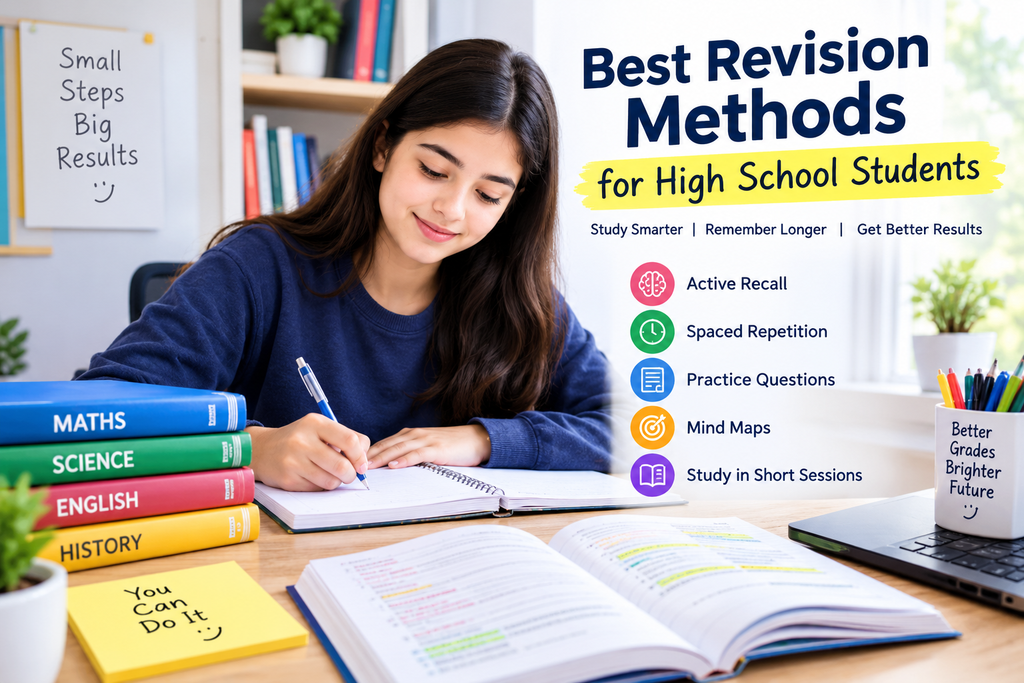
The best revision methods for high school students include active recall, spaced repetition, practice questions, mind mapping, and short study sessions. By combining these techniques with good planning and healthy study habits, students can make their revision time more effective and achieve better academic results.
1. Create a Realistic Revision Timetable
One of the best revision methods for high school students is creating a realistic study timetable. Without a clear plan, students may spend too much time on subjects they enjoy while ignoring difficult topics that require additional practice.
A revision timetable helps students organize their subjects, set priorities, and understand what needs to be completed each day. Instead of trying to study everything at once, students can divide their syllabus into smaller and more manageable sections.
Start by listing all your subjects and identifying the topics that need revision. Give more time to difficult subjects or chapters that carry significant marks in examinations. However, do not completely ignore subjects that seem easier.
For example, a student might study mathematics for 40 minutes, revise biology for 30 minutes, and spend another 30 minutes practicing English grammar. Short breaks can be included between sessions to maintain concentration.
The most important point is to keep the timetable practical. A plan that requires studying for eight hours every day may be difficult to maintain alongside schoolwork and other responsibilities. A consistent routine is usually more helpful than an unrealistic schedule.
2. Use Active Recall to Remember Information
Active recall is one of the most effective study techniques for high school students. It involves trying to remember information without looking at a textbook, notebook, or study guide.
Many students repeatedly read the same chapter because the information begins to feel familiar. However, recognizing information while reading is not the same as remembering it independently.
To practice active recall, read a short section of a chapter and close your book. Then explain the main ideas in your own words. You can also write down important facts, definitions, formulas, or examples from memory.
For instance, after studying the causes of a historical event, close your textbook and list the causes you remember. Once you finish, reopen the book and check which points you missed.
This method helps identify gaps in your understanding. It also gives you regular practice retrieving information, which is useful when answering examination questions.
Students can use active recall for almost every subject, including science, mathematics, history, geography, and language studies. The key is to challenge yourself instead of depending entirely on repeated reading.
3. Practice Spaced Repetition
Spaced repetition is another excellent revision method for high school students. Instead of revising a topic many times in one day, students review it at increasing intervals over several days or weeks.
For example, after learning a new science chapter, you might revise it on the same day, review it again the next day, and return to it after three days. Further reviews can take place after one week and again before the examination.
This approach helps students revisit information before it becomes too difficult to remember. It also reduces the need to relearn entire chapters immediately before exams.
Flashcards are particularly useful for spaced repetition. Write a question on one side and its answer on the other. You can create cards for scientific definitions, mathematical formulas, vocabulary, historical dates, and other important information.
When reviewing flashcards, separate the questions you answer correctly from those you find difficult. Review challenging cards more frequently.
You do not need expensive applications to use spaced repetition. A notebook, paper cards, or a simple revision calendar can work well. What matters most is reviewing information regularly rather than leaving everything until the last minute.
4. Solve Past Papers and Practice Questions
Reading notes can help you understand a topic, but examinations require you to apply your knowledge. This is why solving practice questions and past papers is among the best revision methods for high school students.
Practice questions help you understand the types of questions commonly asked, identify weak areas, and become familiar with examination instructions. They also teach you how to organize answers within a limited amount of time.
Begin with questions related to individual chapters. Once you understand the main concepts, attempt complete practice papers under timed conditions.
After finishing a paper, check your answers carefully. Do not focus only on your score. Examine your mistakes and determine why they happened. You may have misunderstood a question, forgotten a formula, made a calculation error, or provided an incomplete explanation.
Keep a separate notebook for mistakes. Write down the question, the correct answer, and the reason for the error. Review this notebook regularly before examinations.
If official past papers are available through your school or examination board, use them alongside your textbook and teacher’s guidance. Practice materials should support your syllabus rather than replace it.
5. Make Short and Useful Revision Notes
Revision notes can save time when examinations approach. Instead of reading an entire textbook every time you revise, you can use concise notes to review important concepts quickly.
However, making notes should not become a task that consumes all your study time. Copying every sentence from a textbook into a notebook does not necessarily improve understanding.
Good revision notes include essential definitions, important facts, formulas, key examples, and explanations of difficult concepts. Use simple language that makes sense to you.
For example, when revising a biology chapter, you could create a one page summary containing the main processes, important terms, and a labeled diagram. For mathematics, you might prepare a formula sheet with a short example showing how each formula is applied.
Keep your notes organized by subject and chapter. Headings and bullet points can make information easier to find. A limited amount of color coding can also help distinguish definitions, examples, and important reminders.
The purpose of revision notes is to make review faster and clearer. If you can explain a topic using your own short notes, it is a good sign that you understand the material.
6. Use Mind Maps and Visual Learning
Some students understand information more easily when they can see how different ideas connect. Mind maps and other visual learning methods can make complicated topics easier to organize.
A mind map starts with a central topic, with branches leading to related ideas, definitions, examples, or processes. This format is useful for subjects that contain many connected concepts.
For example, a mind map about the human digestive system might include the main organs, their functions, and the sequence in which food moves through the body.
Students can also use diagrams, timelines, flowcharts, and comparison tables. A historical timeline can help organize events chronologically, while a comparison table can show the differences between two scientific concepts.
Visual revision is especially useful when a chapter contains several processes or categories. However, diagrams should be accurate and easy to understand. Spending too much time decorating a mind map can distract you from learning the material.
After creating a visual summary, cover the labels and try to reproduce the diagram from memory. This combines visual learning with active recall and makes the exercise more useful.
7. Break Study Sessions Into Smaller Periods
Long study sessions can become tiring, particularly when students attempt to concentrate on one subject for several hours without taking a break.
Breaking revision into shorter periods can help maintain attention and make difficult tasks feel more manageable. One popular approach is the Pomodoro technique, which involves studying for 25 minutes followed by a five minute break.
After completing several sessions, students can take a longer break before continuing.
For example, you could spend 25 minutes revising algebra, take a five minute break, and then complete another session focused on practice problems. This structure provides clear goals and helps prevent unnecessary distractions.
The ideal session length varies between students and subjects. Some students prefer 25 minute sessions, while others work comfortably for 40 or 50 minutes.
During breaks, stretch, drink water, or walk around briefly. Avoid activities that make it difficult to return to studying, such as opening social media feeds and scrolling without a clear stopping point.
Short study sessions are particularly helpful when you feel overwhelmed by a large syllabus. Completing one small task at a time can build motivation and create a stronger revision routine.
8. Teach the Topic to Someone Else
Teaching is a powerful way to test your understanding. If you can explain a difficult topic clearly to another person, you are more likely to understand its main ideas and relationships.
This technique does not require a classroom or a study partner. You can explain a concept to a friend, a family member, or even yourself.
Choose a topic and describe it in simple language without looking at your notes. When you struggle to explain a point, return to your textbook and review that section.
For example, after revising a mathematical rule, explain what it means, when it is used, and how to apply it to a sample problem. For a science topic, describe the process step by step and explain the purpose of each stage.
Teaching also helps reveal gaps that may remain unnoticed during ordinary reading. It encourages students to organize their thoughts and communicate information clearly.
Study groups can make this technique more enjoyable. Students can take turns explaining different chapters and asking each other questions. Keep the group focused on revision to avoid turning study time into a social gathering.
9. Give Extra Attention to Difficult Subjects
It is natural to prefer subjects that feel easy or enjoyable. However, effective exam preparation requires students to spend enough time on areas where they struggle.
Start by identifying your weakest topics through quizzes, practice papers, and feedback from teachers. Do not simply label an entire subject as difficult. Find the specific concepts or skills that cause problems.
If you struggle with algebra, for example, determine whether the main difficulty involves formulas, calculations, or understanding word problems. Then practice the relevant skill before moving to more advanced questions.
Ask teachers for clarification when necessary. You can also use reliable educational resources that explain the same concept in a different way.
Divide difficult chapters into smaller sections and revise them gradually. Celebrate progress when you can answer questions that previously caused problems.
Spending extra time on weak areas can improve overall performance because it reduces the number of topics you are unable to answer during examinations.
10. Avoid Common Revision Mistakes
Even hardworking students sometimes use revision methods that waste time or increase stress. Recognizing these mistakes can make preparation more effective.
One common mistake is leaving all revision until the final days before an examination. Last minute studying may help with a few facts, but it leaves little time for repeated practice and deeper understanding.
Another mistake is studying while constantly checking a phone. Notifications and social media can interrupt concentration and make it harder to complete tasks efficiently.
Students should also avoid sacrificing sleep to study throughout the night. Adequate sleep supports attention, learning, and memory. A tired student may spend more time studying while understanding less.
Do not compare your revision routine too closely with other students. Different people learn at different speeds and have different responsibilities. Focus on your progress, the quality of your practice, and the topics you still need to improve.
Finally, remember that highlighting and rereading have a place in revision, but they should not be your only methods. Combine them with recall exercises, practice questions, and regular reviews.
11. Maintain Healthy Habits During Exam Preparation
Effective revision depends on more than textbooks and study schedules. Healthy daily habits can help students maintain energy and concentration throughout the school year.
Try to maintain a regular sleep schedule and avoid staying awake unnecessarily late before examinations. Eat balanced meals, drink enough water, and include some physical activity in your routine.
Keep your study area clean and organized. A comfortable desk, suitable lighting, and the materials you need can reduce interruptions.
It is also important to manage exam stress. If you feel overwhelmed, divide your workload into smaller tasks and focus on completing one task at a time. Taking short breaks and talking to a trusted teacher or family member may also help.
Remember that revision is a process. You do not need to master every topic in a single day. Consistent effort, regular practice, and a willingness to learn from mistakes can gradually improve your confidence.
Conclusion
The best revision methods for high school students are those that make learning active, organized, and consistent. Techniques such as active recall, spaced repetition, practice questions, concise notes, mind maps, and short study sessions can help students understand their subjects and prepare more confidently for examinations.
In my view, the most effective approach is to combine several methods rather than depend on one technique alone. Use a timetable to organize your workload, test your memory regularly, solve examination questions, and spend additional time on difficult topics.
Most importantly, start revising early and make small improvements to your daily routine. You do not need to study every hour of the day to make progress. With a practical plan, healthy habits, and consistent effort, high school students can develop better revision skills and work toward stronger academic results.