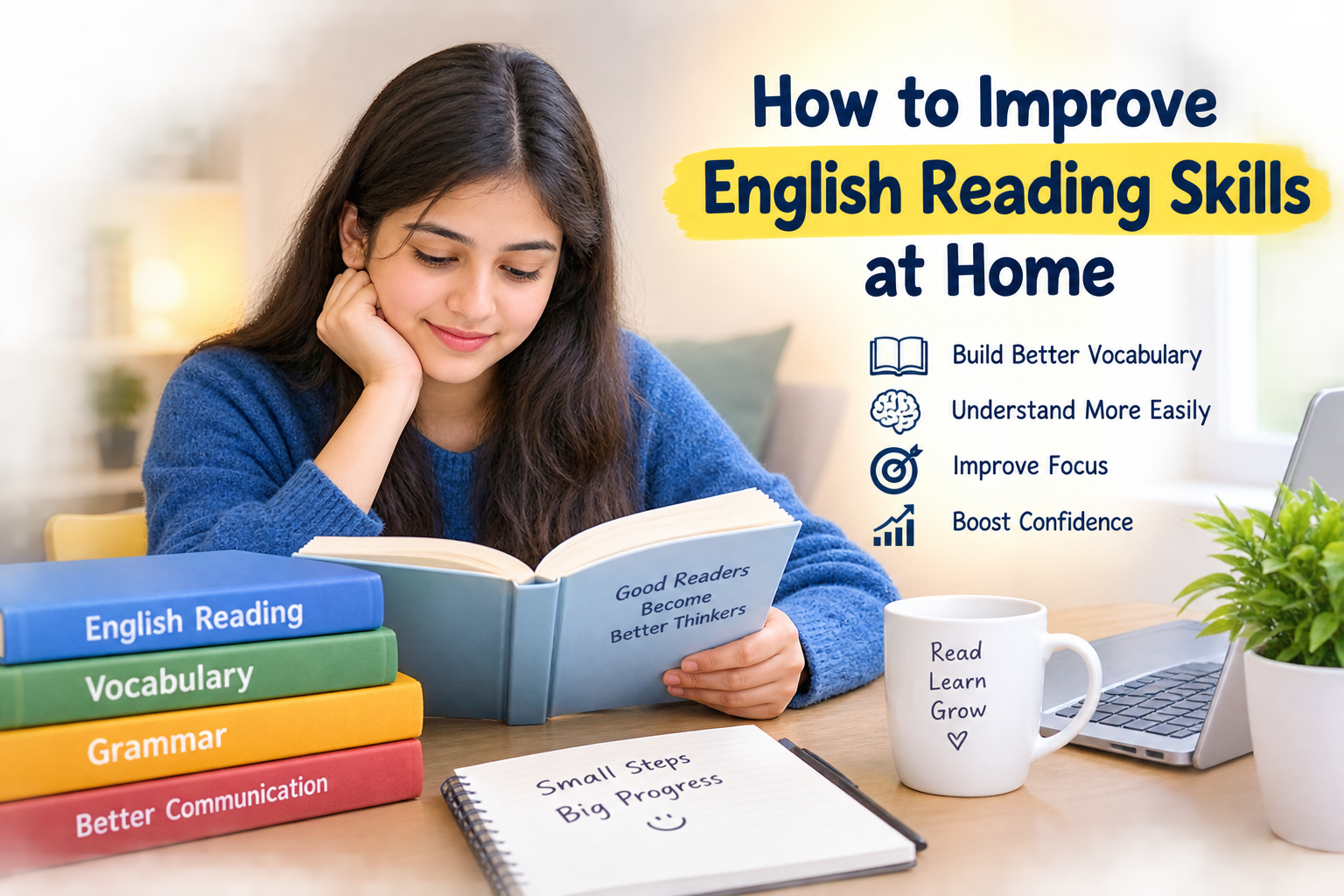
Reading is one of the most important skills for learning English. In my opinion, anyone can improve their English reading skills with regular practice, patience, and the right learning methods. You do not need to join an expensive academy or buy a lot of books to become a better reader. You can start learning at home with simple English stories, newspapers, schoolbooks, online articles, and other reading materials.
Many students and beginners find English reading difficult because they do not understand every word. Some readers stop after seeing an unfamiliar word, while others read entire paragraphs without understanding their meaning. These problems are common, especially for people who are learning English as a second language.
The good news is that you can overcome these difficulties by developing a daily reading habit. In this article, I will share practical tips on how to improve English reading skills at home, build vocabulary, understand sentences, and become a more confident reader.
1. Start With Easy English Reading Materials
In my experience, choosing the right reading material is one of the first steps toward improving English reading skills. Beginners should avoid starting with difficult novels, advanced newspapers, or complicated academic books. These materials can make learning stressful and reduce motivation.
Instead, begin with simple English stories, short paragraphs, children’s books, and beginner level articles. Choose content that matches your current English level.
For example, you can read a short story about a family, a school day, a visit to the market, or a daily routine. These topics usually contain familiar words and simple sentences.
When you understand most of what you read, you can gradually move toward more challenging material. This approach helps you improve your reading comprehension without feeling overwhelmed.
Remember that the purpose of reading practice is not simply to finish a page. The real goal is to understand the message and learn something useful.
2. Make English Reading a Daily Habit
One of the best ways to improve English reading skills at home is to practise every day. You do not need to spend several hours reading. Even 15 to 20 minutes of focused practice can help you build consistency.
Try to choose a specific time for reading. You might read in the morning before school, during a break, or in the evening before going to bed.
A simple daily routine could look like this:
- Spend five minutes reviewing familiar vocabulary.
- Read an English paragraph for ten minutes.
- Write down three new words.
- Spend five minutes explaining what you have read.
This routine is simple enough for beginners and school students to follow.
I believe regular practice is more useful than studying for a long time only once or twice a week. When reading becomes part of your daily routine, you become more comfortable with English words, sentence patterns, and common expressions.
3. Read Aloud to Improve Understanding
Reading aloud is another helpful technique for English learners. It allows you to see words, pronounce them, and connect written language with spoken English.
Choose a short paragraph from a storybook or article and read it aloud at a comfortable speed. Focus on pronouncing words clearly instead of trying to read as quickly as possible.
If you find a difficult word, check its pronunciation using a reliable dictionary or an English pronunciation tool. Then repeat the word and read the complete sentence again.
Reading aloud can also help you notice punctuation. A full stop signals the end of a sentence, while a comma often indicates a short pause. Question marks and exclamation marks can also guide your expression.
However, do not worry if your pronunciation is not perfect at first. The main purpose is to practise regularly and become more comfortable with English.
4. Learn New Vocabulary From Context
Vocabulary plays an important role in reading comprehension. When you know more English words, it becomes easier to understand stories, instructions, articles, and school assignments.
However, you do not need to memorise every unfamiliar word immediately.
When you encounter a new word, first read the complete sentence. Try to understand its meaning from the surrounding words. The context often provides clues that help you guess what the writer is trying to say.
For example, consider this sentence:
“Ali was exhausted after running for an hour, so he sat down to rest.”
Even if you do not know the word “exhausted,” the rest of the sentence suggests that Ali was very tired.
After guessing the meaning, check a dictionary to confirm it. Write the word in a notebook along with its meaning and an example sentence.
I recommend learning three to five useful words each day rather than memorising a long list without understanding how the words are used.
Review your vocabulary regularly so that new words become part of your everyday English.
5. Understand the Main Idea of Each Paragraph
Some learners focus so much on individual words that they forget to understand the overall meaning of a paragraph. This makes reading slower and more difficult.
To improve English reading comprehension, try to identify the main idea of every paragraph.
After reading a paragraph, ask yourself three simple questions:
- What is this paragraph about?
- What information is the writer explaining?
- What is the most important point?
For example, if you read a paragraph about healthy eating, the main idea might be that balanced meals help people maintain their health.
You do not need to remember every detail. Start by understanding the central message, then return to important details if necessary.
This method is especially useful for students who need to understand textbooks, prepare for examinations, or answer comprehension questions.
6. Use a Dictionary Wisely
A dictionary is a useful learning tool, but checking every unfamiliar word can interrupt your reading.
Instead, decide which words are important to understand the passage. If a word appears repeatedly or prevents you from understanding the main idea, look it up.
For less important words, try to guess the meaning from the context and continue reading.
You can use a printed English dictionary or a trusted online dictionary. Many dictionaries provide definitions, pronunciation guides, example sentences, and information about how words are used.
When you look up a word, do not memorise only its meaning. Read the example sentence and notice how the word fits into a complete sentence.
For instance, learning the word “improve” is more useful when you also understand phrases such as “improve reading skills,” “improve your writing,” and “improve your performance.”
Using a dictionary in this way can strengthen your vocabulary and help you become an independent English learner.
7. Read Topics That Interest You
Reading becomes more enjoyable when you choose subjects that you genuinely like. If you enjoy sports, read short articles about your favourite games. If you like technology, explore beginner friendly technology articles. Students can also read stories about school, friendship, nature, and everyday life.
In my opinion, interest is an important part of building a long term reading habit. When the topic is enjoyable, you are more likely to continue reading even when you encounter a few difficult words.
You can explore different types of reading material, including:
- Short English stories
- Educational blog posts
- Children’s books
- Newspaper articles written in simple English
- Informative school passages
- Beginner level English magazines
Try different options until you find materials that suit your interests and reading level.
You should also gradually explore new topics. Reading about different subjects exposes you to new vocabulary and helps you understand a wider range of English texts.
8. Practise Skimming and Scanning
Skimming and scanning are useful reading techniques that help you find information efficiently.
Skimming means reading quickly to understand the general idea of a text. You can look at the title, headings, first sentences, and conclusion to identify what the content is about.
Scanning means searching for a specific piece of information, such as a date, name, price, keyword, or number.
For example, if you are reading an article about improving English grammar, you might skim the headings to understand its structure. If you want to find a particular grammar rule, you can scan the page for the relevant keyword.
These techniques are especially helpful for students preparing for English examinations and people who read online content regularly.
However, do not use speed reading for every task. When you study an important passage or learn new vocabulary, slower and more careful reading may be more effective.

9. Summarise What You Read
Summarising is one of the best ways to check whether you have understood a passage.
After finishing a short story or article, write two or three sentences explaining its main message. Try to use your own words instead of copying complete sentences from the original text.
For example, if you read a story about a student who works hard to achieve a goal, your summary might explain what the student wanted, what difficulties appeared, and how the student solved them.
This exercise helps you identify the main idea, remember important details, and practise English writing at the same time.
If writing is difficult, explain the passage aloud first. Then write a short summary using simple sentences.
You can also ask a family member or friend to listen to your explanation. This gives you an opportunity to practise expressing ideas clearly.
10. Reduce Distractions While Reading at Home
Your learning environment can influence the quality of your reading practice. A noisy room, frequent phone notifications, or constant interruptions can make it difficult to concentrate.
Choose a comfortable place where you can read without unnecessary distractions. Keep your book, notebook, pen, and dictionary nearby so that you do not need to interrupt your practice frequently.
If you prefer reading on a phone or computer, turn off notifications for a short period. Adjust the screen brightness and text size to make reading comfortable.
You do not need a separate study room. A quiet corner of your bedroom or a clean table can be enough.
The most important thing is to create an environment that helps you focus on understanding the text.
11. Use Free Online Resources for English Reading Practice
The internet provides many opportunities to improve English reading skills at home. You can find free stories, educational articles, vocabulary exercises, and reading comprehension activities suitable for different levels.
Choose reliable educational websites that provide clear explanations and age appropriate content. Beginners should look for short passages with simple vocabulary, while intermediate learners can explore longer articles and more detailed stories.
You can also read digital books or use online dictionaries to check unfamiliar words.
If you prefer printed material, download or print short reading passages when permitted by the website. This can help you practise without looking at a screen for the entire session.
Always choose appropriate websites and avoid clicking suspicious advertisements or downloading files from untrusted sources.
Remember that online resources are most effective when you use them with a clear learning goal. For example, you might focus on understanding the main idea today and learning new vocabulary tomorrow.
12. Follow a Simple Weekly Reading Plan
A weekly reading plan can help you stay organised and track your progress.
Here is a simple schedule for beginners who want to improve English reading skills at home.
| Day | Reading activity |
|---|---|
| Monday | Read a short English story |
| Tuesday | Read a paragraph and learn new vocabulary |
| Wednesday | Read aloud for ten minutes |
| Thursday | Practise reading comprehension questions |
| Friday | Read an educational article |
| Saturday | Write a summary of a story |
| Sunday | Review vocabulary and reread a favourite passage |
You can adjust this plan according to your school schedule, work, or personal responsibilities.
At the end of each week, think about what you have learned. Are you understanding more words? Can you read a paragraph with fewer interruptions? Are you becoming more comfortable with longer sentences?
These small signs of progress can help you remain motivated.
13. Avoid Common English Reading Mistakes
Many learners make a few common mistakes when practising English reading. Fortunately, these habits can be improved with awareness and regular effort.
Trying to understand every word: You do not always need to know every word to understand the main message. Use context and look up only important unfamiliar words.
Reading too quickly: Speed is not the main goal for beginners. Focus on understanding before trying to increase your reading speed.
Choosing difficult books too early: Start with suitable material and gradually increase the difficulty as your skills develop.
Ignoring regular practice: Reading occasionally makes it harder to build a consistent habit. Set aside a small amount of time every day.
Never reviewing vocabulary: New words are easier to forget when you do not use or review them. Keep a vocabulary notebook and revisit it regularly.
By avoiding these mistakes, you can make your home reading practice more effective and enjoyable.
Conclusion
Improving English reading skills at home is possible for anyone who is willing to practise consistently. You do not need expensive courses or complicated learning methods. Start with easy reading materials, develop a daily routine, learn useful vocabulary, and focus on understanding the main idea of each passage.
In my opinion, the most important step is to remain patient with yourself. You may not understand every sentence during your first few weeks, and that is completely normal. As you continue reading, you will become more familiar with English vocabulary, grammar patterns, and sentence structures.
Choose topics you enjoy, use a dictionary when necessary, and summarise what you read to check your understanding. Most importantly, celebrate small improvements instead of comparing your progress with other learners.
With regular practice and a positive attitude, you can gradually become a more confident English reader. Start with just 15 minutes today, and make English reading a valuable part of your daily life.