Introduction
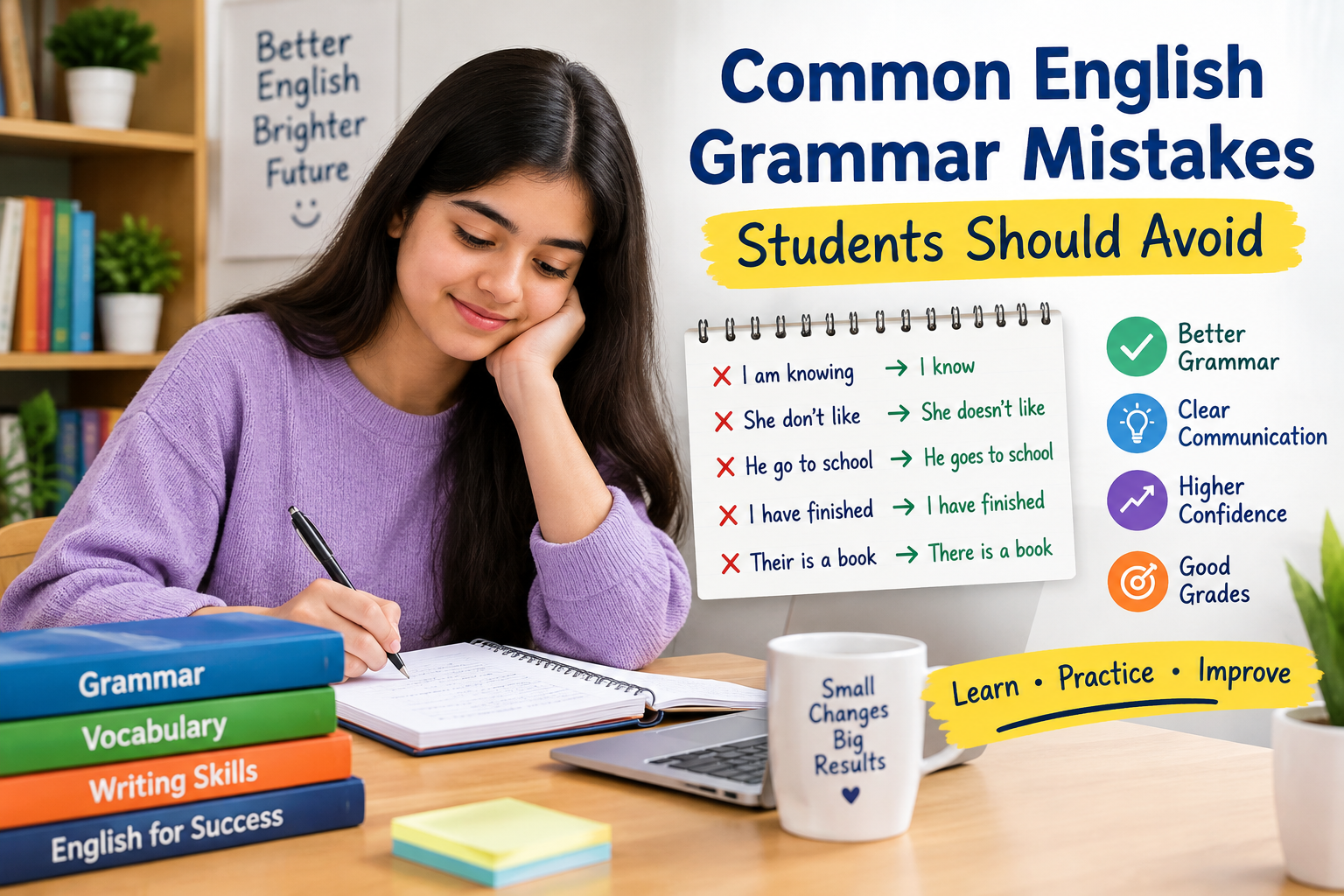
English grammar plays an important role in speaking, reading, and writing. Whether students are preparing for school exams, writing assignments, learning English as a second language, or improving their communication skills, good grammar helps them express their ideas clearly. However, many students make common English grammar mistakes without realizing that small errors can change the meaning of a sentence.
In my view, learning English grammar should not be a difficult or stressful process. Students do not need to memorize every grammar rule in one day. Instead, they should understand the basic rules, practice regularly, and learn from their mistakes. Even students who know many English words can struggle to write correct sentences if they do not understand how grammar works.
The good news is that most common grammar mistakes can be corrected with simple explanations and daily practice. By learning about subject verb agreement, tenses, punctuation, articles, prepositions, and sentence structure, students can gradually improve their English skills.
In this article, I will explain the most common English grammar mistakes students should avoid and share practical tips that can help beginners and school students write better English with confidence.
1. Subject Verb Agreement Mistakes
One of the most common English grammar mistakes is using the wrong verb with a subject. In English, the verb must agree with its subject in number and person.
For example, we say, “He plays cricket,” but “They play cricket.” The verb changes depending on whether the subject is singular or plural.
Incorrect: She go to school every day.
Correct: She goes to school every day.
Incorrect: They likes English.
Correct: They like English.
Students often make this mistake because they focus on the subject without checking the verb. My advice is to identify the subject before writing the verb. Ask yourself whether the subject is singular or plural and choose the correct verb form.
Regular practice with short sentences can make subject verb agreement much easier to understand.
2. Confusing Present, Past, and Future Tenses
English tenses explain when an action happens. They help readers understand whether something takes place in the present, happened in the past, or will happen in the future.
Many students mix different tenses in the same sentence without a good reason. This can make their writing confusing.
Incorrect: Yesterday, I go to the market.
Correct: Yesterday, I went to the market.
Incorrect: She will visited her friend tomorrow.
Correct: She will visit her friend tomorrow.
Incorrect: I am study English every day.
Correct: I study English every day.
To avoid these English tense mistakes, students should learn the basic forms of common verbs and understand how time expressions work. Words such as yesterday, today, usually, and tomorrow can help you identify the intended tense.
I recommend practicing one tense at a time before moving on to more advanced grammar. Once you understand the basic patterns, you will find it easier to write sentences accurately.
3. Using Articles Incorrectly
Articles are small words, but they are very important in English grammar. The three articles are a, an, and the.
Students sometimes forget articles or use them incorrectly because their native language may follow different rules.
Use a before a singular countable noun that begins with a consonant sound, and use an before a singular countable noun that begins with a vowel sound.
Examples:
Incorrect: I bought book.
Correct: I bought a book.
Incorrect: She is an university student.
Correct: She is a university student.
The word university begins with a consonant sound, so we use a. The rule depends on pronunciation, not simply the first letter.
Use the when referring to something specific that the reader or listener can identify.
Example: I saw a dog outside. The dog was very friendly.
Students should pay attention to articles while reading English books, stories, and articles. Observing how these words are used in real sentences is an effective way to improve grammar naturally.
4. Confusing “Your” and “You’re”
Another common English grammar mistake is confusing your with you’re. These words sound similar, but their meanings are different.
Your shows possession. It tells us that something belongs to someone.
Example: Your notebook is on the table.
You’re is the short form of you are.
Example: You’re doing a great job.
Incorrect: Your very intelligent.
Correct: You’re very intelligent.
Incorrect: You’re book is interesting.
Correct: Your book is interesting.
A simple trick is to replace you’re with you are. If the sentence still makes sense, you’re is probably correct. If it does not, you may need your.
Understanding this difference will help students avoid unnecessary mistakes in school assignments, emails, messages, and examinations.
5. Confusing “There,” “Their,” and “They’re”
These three words are pronounced similarly, but each has a different meaning. Students often confuse them when writing quickly.
There refers to a place or helps introduce a statement.
Example: The library is over there.
Their shows possession.
Example: Their teacher is very helpful.
They’re means they are.
Example: They’re preparing for their exams.
Incorrect: Their going to the park.
Correct: They’re going to the park.
Incorrect: The students forgot there books.
Correct: The students forgot their books.
In my opinion, the best way to remember these words is to write three separate example sentences for each one. Repeating this activity for a few minutes each day can help students use them correctly without hesitation.
6. Making Mistakes With Singular and Plural Nouns
Nouns name people, places, objects, and ideas. In English, many nouns become plural when we add s or es. However, some nouns follow irregular patterns.
Incorrect: I have two book.
Correct: I have two books.
Incorrect: She bought three boxs.
Correct: She bought three boxes.
Some nouns have irregular plural forms.
- Child becomes children.
- Man becomes men.
- Woman becomes women.
- Foot becomes feet.
- Tooth becomes teeth.
Students should also remember that some nouns are generally uncountable, such as information, advice, and furniture.
Incorrect: She gave me many advices.
Correct: She gave me some advice.
Incorrect: I need an information.
Correct: I need some information.
Learning common plural forms and uncountable nouns can improve both spoken and written English. Whenever you write a sentence containing a number, check whether the noun should be singular or plural.
7. Using Prepositions Incorrectly
Prepositions show relationships involving time, place, direction, and other connections. Common prepositions include in, on, at, to, for, from, and with.
Students sometimes select the wrong preposition because English expressions do not always follow predictable rules.
Examples:
Incorrect: I am good in English.
Correct: I am good at English.
Incorrect: She is interested on music.
Correct: She is interested in music.
Incorrect: We arrived to the station.
Correct: We arrived at the station.
Some prepositions are connected to particular words and expressions. For example, we say afraid of, depend on, listen to, and believe in.
To improve your understanding, learn prepositions as part of complete phrases instead of memorizing them individually. Reading, listening to English conversations, and creating your own sentences can help you recognize the correct combinations.
8. Confusing “Much” and “Many”
The words much and many are both used to talk about quantities, but they are not interchangeable in most standard English sentences.
Use many with plural countable nouns.
Example: How many students are in your class?
Use much with uncountable nouns.
Example: How much water do you drink every day?
Incorrect: I have much friends.
Correct: I have many friends.
Incorrect: How many money do you need?
Correct: How much money do you need?
Students should learn to identify whether a noun is countable or uncountable. This simple skill makes it easier to choose the right word when asking questions or describing quantities.
Remember that informal English sometimes uses these words differently for emphasis, but beginners should first master their standard grammatical uses.
9. Incorrect Sentence Structure
A grammatically correct sentence usually needs a subject and a verb, along with any additional information required to complete its meaning.
Students sometimes write incomplete sentences because they leave out essential words or connect ideas incorrectly.
Incorrect: Because I was tired.
Correct: I went to bed early because I was tired.
The first example is a dependent clause. It introduces a reason but does not complete the thought on its own in this context.
Another common mistake is joining two independent sentences with only a comma.
Incorrect: I studied hard, I passed the exam.
Correct: I studied hard, and I passed the exam.
You could also write: I studied hard. I passed the exam.
When writing an English paragraph, check whether every sentence expresses a complete idea. Read your work aloud to see whether the sentences sound natural and communicate your intended meaning.
10. Forgetting Capital Letters and Punctuation
Capitalization and punctuation may seem like small details, but they make written English easier to read and understand.
Students should capitalize the first word of a sentence, the pronoun I, and proper nouns such as people’s names, cities, countries, and days of the week.
Incorrect: my friend ali lives in pakistan.
Correct: My friend Ali lives in Pakistan.
Punctuation is equally important. A full stop marks the end of a statement, a question mark ends a direct question, and commas help organize information.
Incorrect: where are you going.
Correct: Where are you going?
Incorrect: I bought apples bananas oranges and grapes.
Correct: I bought apples, bananas, oranges, and grapes.
The final comma in a list, called the Oxford comma, is common in many English styles, although its use depends on the style guide. Consistency is important.
Before submitting an assignment, check capitalization, commas, full stops, and question marks. These small improvements can make your writing look more polished.
11. Confusing “Then” and “Than”
The words then and than are often confused because they look similar.
Then usually refers to time, sequence, or what happens next.
Example: I finished my homework, then I watched television.
Than is used to compare people, things, or situations.
Example: English is easier for me than mathematics.
Incorrect: My brother is taller then me.
Correct: My brother is taller than me.
Incorrect: First, wash your hands than prepare the food.
Correct: First, wash your hands, then prepare the food.
A useful way to remember the difference is to connect then with the order of events and than with comparisons. Practice writing sentences using both words to make the distinction clear.
12. Misusing Adjectives and Adverbs
Adjectives describe nouns, while adverbs often describe verbs, adjectives, or other adverbs. Choosing the wrong form can make a sentence grammatically incorrect.
Incorrect: She sings beautiful.
Correct: She sings beautifully.
Incorrect: He is a carefully driver.
Correct: He is a careful driver.
However, not every adverb ends in ly, and some verbs are correctly followed by adjectives rather than adverbs.
For example, we say, “She looks happy,” because happy describes her condition. We also say, “He runs fast,” because fast can function as an adverb without an ly ending.
Students should learn how words function within sentences rather than relying entirely on word endings. Pay attention to whether you are describing a person or thing, or explaining how an action happens.
13. Using Double Negatives Incorrectly
A double negative occurs when two negative expressions are used together in a way that creates a nonstandard negative construction.
For example:
Incorrect in standard English: I don’t know nothing.
Correct: I don’t know anything.
Incorrect in standard English: She never says nothing.
Correct: She never says anything.
In some dialects, double negatives follow established grammatical patterns, but in standard academic English, students should generally avoid using two negative expressions to communicate a single negative meaning.
Instead, use words such as not, never, nothing, nobody, and anything carefully.
Understanding this rule is particularly useful for school essays, formal writing, and examinations.
14. Confusing “Can” and “Could”
The words can and could are modal verbs used to express ability, possibility, and requests. Although they are related, they are not always used in the same situations.
Examples:
- I can speak English.
- When I was younger, I could run very fast.
- Could you please help me with this question?
Students sometimes use incorrect verb forms after modal verbs.
Incorrect: She can speaks English.
Correct: She can speak English.
Incorrect: He could went home early.
Correct: He could go home early.
One important rule is that modal verbs such as can, could, should, and must are generally followed by the base form of the main verb.
For example, we say “You should study,” not “You should studied.”
Learning this simple rule can prevent many common English grammar mistakes and help students form sentences correctly.
15. How Students Can Avoid English Grammar Mistakes
Understanding grammar rules is important, but applying them consistently requires practice. I believe students can improve their English grammar by developing a few simple daily habits.
Read English every day. Reading books, short stories, educational articles, and school materials exposes you to correct sentence structures. Notice how writers use tenses, articles, prepositions, and punctuation.
Practice writing regularly. Write a short paragraph about your daily routine, studies, hobbies, or personal experiences. After writing, check your work for common grammar mistakes.
Keep a grammar notebook. Whenever you make a mistake, write the incorrect sentence, the corrected sentence, and a short explanation. Review these examples regularly so you do not repeat the same errors.
Learn one rule at a time. Trying to memorize too many grammar rules at once can be confusing. Focus on one topic, such as subject verb agreement, before moving to another.
Read your sentences aloud. Sometimes, reading aloud helps you notice missing words, awkward sentences, and incorrect verb forms. However, remember that some grammatical errors sound natural because of familiar speaking habits, so checking the rules is still important.
Ask for feedback. Teachers, classmates, and proficient English speakers can help you identify mistakes you may not notice yourself. Treat corrections as opportunities to learn rather than reasons to feel embarrassed.
Use grammar checking tools wisely. Digital grammar checkers can identify many spelling, punctuation, and sentence structure problems. However, they may miss errors or suggest changes that do not fit your intended meaning. Always try to understand a correction before accepting it.
Conclusion
Common English grammar mistakes are a normal part of learning a language. Students may struggle with verb tenses, articles, prepositions, subject verb agreement, punctuation, and sentence structure, especially when they are beginners. However, these difficulties become easier to manage through regular practice and a clear understanding of basic grammar rules.
In my opinion, the most effective way to improve English grammar is to learn from everyday mistakes instead of worrying about making them. Start by identifying the errors you make most frequently, practice correcting them, and apply what you learn in your writing and conversations.
Remember that becoming confident in English takes time. You do not need to become perfect overnight. Even a few minutes of focused grammar practice every day can help you build stronger writing skills, perform better in examinations, and communicate more confidently.
Make learning a daily habit, stay patient, and continue improving. With consistent effort, you can avoid common English grammar mistakes and develop the skills needed to write clear, accurate, and effective English.