Introduction
Problem solving is one of the most important skills students can develop during their school years. In my opinion, education should not only focus on memorizing information and passing exams. Students should also learn how to think independently, make decisions, understand challenges, and find practical solutions. These abilities help them become more confident in the classroom and in everyday life.
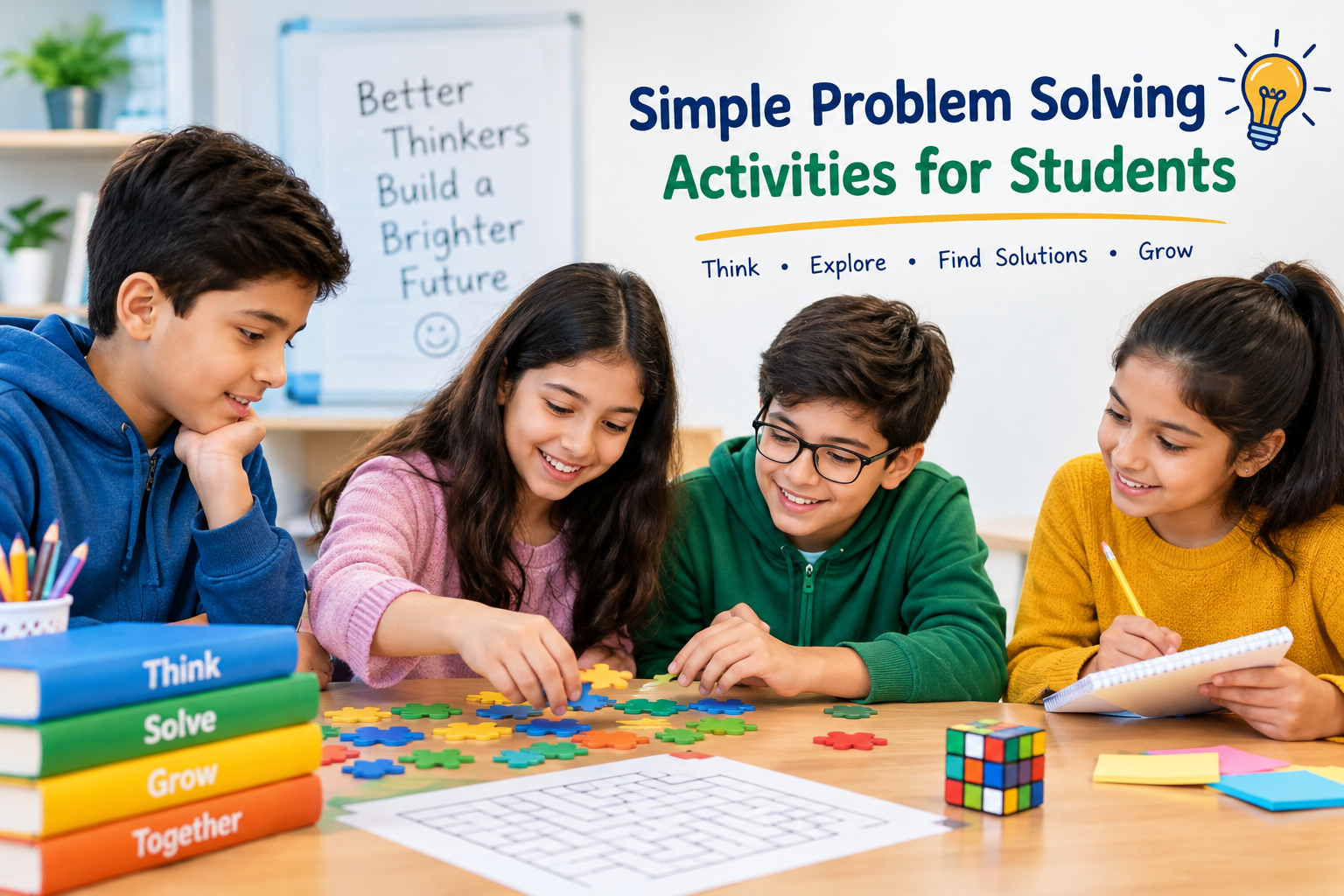
Simple problem solving activities for students can make learning more interesting and effective. Instead of only listening to a teacher or reading a textbook, students get opportunities to explore ideas, ask questions, and discover answers on their own. These activities can be used at school, at home, or during group learning sessions.
The good thing is that problem solving does not always require expensive equipment or complicated lessons. Simple puzzles, teamwork challenges, everyday situations, and creative tasks can help students improve their thinking skills. In this article, I will share some easy problem solving activities for students that parents and teachers can introduce without much preparation.
Why Problem Solving Skills Are Important for Students
I believe problem solving skills are essential because students face different challenges throughout their educational journey. They may struggle with a difficult mathematics question, find it hard to organize homework, or disagree with classmates during group projects. Learning how to approach these situations calmly can make a real difference.
Problem solving activities encourage students to think logically, consider different possibilities, and understand that there may be more than one way to solve a problem. They also help develop patience because some challenges require time and repeated attempts.
Another important benefit is improved confidence. When students find an answer independently, they begin to trust their abilities. They may also become more willing to participate in class discussions and try unfamiliar tasks.
These activities can support creativity, communication, decision making, and teamwork. With regular practice, students can learn to approach challenges with a positive attitude rather than immediately giving up.
1. Solve Simple Puzzles and Riddles
Puzzles and riddles are among the easiest problem solving activities for students. They encourage children to think carefully, identify clues, and connect different pieces of information.
Teachers can introduce word riddles, number puzzles, picture puzzles, mazes, or age appropriate logic questions. For younger students, simple matching games and picture puzzles are suitable starting points. Older students can work on more challenging brain teasers.
For example, ask students to find a number that becomes 15 when multiplied by three. They need to think about the relationship between multiplication and division to find the answer.
I recommend allowing students enough time to think before revealing the solution. The main purpose is not simply to get the correct answer but to understand the reasoning behind it.
2. Use Everyday Problems as Learning Activities
One effective way to develop problem solving skills is to connect classroom learning with real life. Students often understand ideas more easily when they can relate them to familiar situations.
For example, ask students to imagine that they have a limited amount of money to buy supplies for a school project. They must decide which items are necessary, compare prices, and stay within their budget.
Another activity could involve planning how to organize a classroom library. Students can decide where books should go, how to label shelves, and how to make books easy to find.
These everyday problem solving activities teach students to evaluate choices and think about consequences. They also show that problem solving is useful beyond examinations and homework.
3. Build a Tower With Simple Materials
A tower building challenge is an enjoyable activity for developing creativity, teamwork, and critical thinking. Students can use paper, drinking straws, cardboard, or building blocks, depending on the materials available and the age group.
Divide students into small teams and give each team the same materials. Ask them to build the tallest tower that can stand independently for a short period.
Before they begin, encourage them to discuss their design. They can decide which materials to use, how to create a stable base, and how to prevent the structure from falling.
If the tower collapses, encourage students to identify the problem and try a different approach. This teaches them that mistakes are part of learning.
The activity also helps students practice communication because team members must listen to each other’s suggestions and agree on a plan.
4. Play the Classroom Mystery Game
Mystery games encourage students to observe details, collect information, and use logical reasoning. They can be adapted for different subjects and age groups.
For example, a teacher can describe a fictional situation in which a classroom object is missing. Students receive several clues and must determine where the object might be.
Each clue should provide useful information without making the answer immediately obvious. Students can write down possible explanations and explain why certain options seem more likely than others.
Teachers can also use mystery activities in science, mathematics, reading, and social studies. Students might identify an unknown animal from its characteristics or discover which character made a particular decision in a story.
I find this approach useful because it makes students active participants in learning rather than passive listeners.
5. Practice Group Problem Solving
Group activities help students understand that different people can approach the same problem in different ways. Working together also develops listening, communication, and cooperation.
Choose a simple challenge, such as planning a class event, designing a recycling campaign, or deciding how to improve the school playground. Divide students into small groups and ask each group to identify the main problem before suggesting solutions.
Every student should have an opportunity to share an idea. The group can then compare the suggestions and select the option that best meets the challenge.
Teachers should encourage respectful disagreement. Students need to understand that questioning an idea is not the same as criticizing the person who suggested it.
This activity teaches children how to consider different opinions and reach decisions as a team.
6. Create a Maze Challenge
Maze activities are simple, affordable, and suitable for many age groups. Students must find a path from the starting point to the finish while avoiding blocked routes.
Teachers can print a maze, draw one on paper, or create a larger maze using classroom objects. Younger students can begin with short paths, while older students can solve more complex designs.
To make the activity more educational, ask students to explain why they selected a particular route. If they reach a dead end, encourage them to return to an earlier point and try another direction.
This activity supports planning, attention to detail, and flexible thinking. It also teaches an important lesson: when one approach fails, another approach may work.
7. Use Creative Story Problems
Creative story problems combine imagination with logical thinking. Students receive a situation and must develop a reasonable solution.
For example, ask students to imagine that their class is preparing for an outdoor activity when it suddenly starts raining. What could they do to continue the activity safely and enjoyably?
Students might suggest moving indoors, choosing a different activity, or rescheduling the event. Ask them to explain the advantages and disadvantages of each option.
Another example is asking students to imagine that they have to complete three assignments before bedtime. They must organize their tasks and decide how to use their available time.
These activities improve planning and decision making while allowing students to express their creativity.
8. Try Simple Science Experiments
Science experiments provide practical opportunities for students to investigate problems and test possible solutions. They can ask questions, make predictions, observe results, and improve their methods.
One simple activity involves testing which materials can absorb the most water. Students can compare small pieces of paper towel, cloth, and other safe household materials using equal amounts of water.
Before beginning, ask students to predict which material will absorb the most water and explain their reasoning. After testing, they can compare the results with their predictions.
Another activity involves designing a paper airplane and testing how different folds affect its flight. Students can change one feature at a time and observe what happens.
Adult supervision is important whenever experiments involve tools, liquids, or unfamiliar materials. The goal is to encourage curiosity and careful observation in a safe learning environment.
9. Introduce Decision Making Games
Decision making is a major part of problem solving. Students often need to choose between several options, and these activities help them think about the possible results.
Present students with a situation in which they must choose how to spend a limited amount of time or resources. For example, a student may have 30 minutes to revise a lesson, organize school supplies, and complete a short assignment.
Ask students to decide what they should do first and explain why. Different students may choose different approaches, and that can lead to a valuable discussion.
Teachers can also create decision cards containing everyday situations. Students select a possible solution and describe what might happen next.
These games encourage students to think before acting and understand that good decisions depend on the available information and priorities.
10. Encourage Students to Find Multiple Solutions
An important part of problem solving is understanding that many challenges have more than one possible answer. Students should learn to explore different options instead of stopping at the first idea.
Give students a question such as, “How can we reduce paper waste in our classroom?” Ask them to suggest as many realistic solutions as possible.
They might use both sides of paper, share unused materials, submit certain assignments digitally when permitted, or place a recycling box in the classroom.
Once students have listed their ideas, ask them to compare the cost, practicality, and likely benefits of each option.
This activity develops flexible thinking and helps students understand how to evaluate possible solutions.
Tips for Making Problem Solving Activities More Effective
To get the best results, teachers and parents should create an environment where students feel comfortable asking questions and making mistakes.
First, choose activities that match the student’s age and current abilities. A task that is too difficult may cause frustration, while an activity that is too easy may not encourage much thinking.
Second, avoid giving the answer immediately. Offer hints and guiding questions so students can discover solutions independently. Questions such as “What have you tried so far?” and “What else could work?” can encourage deeper thinking.
Third, focus on the process as well as the result. A student who tries a reasonable strategy but reaches the wrong answer may still learn something valuable.
Finally, provide opportunities for students to explain their thinking. When they describe how they solved a challenge, teachers can better understand their reasoning and identify areas where additional support may help.
How Parents Can Support Problem Solving at Home
Parents do not need special teaching equipment to encourage problem solving. Everyday family activities can provide useful learning opportunities.
Children can help plan a shopping list, organize their study space, sort household items, or decide how to prepare for a family outing. Parents can ask simple questions that encourage children to compare options and explain their decisions.
Board games, construction toys, puzzles, and age appropriate cooking tasks can also help develop planning and reasoning skills. When children encounter a difficulty, give them a chance to suggest solutions before stepping in.
It is important to remember that children develop at different rates. Some may solve problems quickly, while others need additional time or guidance. Encouragement and regular practice are more useful than comparing one child with another.
Conclusion
Simple problem solving activities for students can make education more practical, engaging, and enjoyable. From puzzles and maze challenges to science experiments and group projects, these activities help students develop logical thinking, creativity, communication, and decision making skills.
In my opinion, the best way to teach problem solving is to give students opportunities to explore challenges themselves. Teachers and parents can guide them, ask helpful questions, and encourage them to learn from mistakes without expecting every attempt to be perfect.
By including these activities in everyday learning, we can help students become more independent and confident thinkers. The skills they develop will support them not only in school but also in future studies and everyday life.