

Introduction
Writing a student CV with no work experience can feel difficult, especially when you are applying for your first job, internship, or part time position. Many students believe they cannot create a strong CV because they have never worked for a company. However, I believe that a good CV is not only about professional experience. It is also about showing your education, skills, achievements, personal qualities, and willingness to learn.
When I think about a student’s first CV, I consider it an opportunity to introduce their potential to an employer. You may have completed school projects, participated in group activities, learned computer skills, or helped organize an event. These experiences can demonstrate your abilities even if you have never received a salary.
In this article, I will explain how to write a student CV with no work experience, what information to include, which mistakes to avoid, and how to make your CV look professional.
1. Start With Your Personal Information
The first section of your student CV should contain your basic contact information. Employers need to know who you are and how they can contact you if they want to arrange an interview.
Include your full name, phone number, professional email address, and city or general location. If you have a LinkedIn profile that supports your career goals, you can include its link as well.
Choose an email address that looks professional and is easy to read. An address based on your name is usually a better choice than one containing unnecessary nicknames or random numbers.
You do not need to include your complete home address, national identification number, religion, or other personal details unless they are specifically required and appropriate for the application.
Keep this section simple and organized. The goal is to help the employer find your contact information quickly.
2. Write a Strong Personal Profile
A personal profile is a short introduction at the beginning of your CV. It explains who you are, what you are studying, which skills you have, and what kind of opportunity you are seeking.
Since you have no work experience, this section is especially useful because it allows you to focus on your strengths.
For example:
“Motivated and responsible student with strong communication, teamwork, and problem solving skills. Currently studying business administration and interested in gaining practical experience through an entry level position. Eager to learn new skills, contribute to a team, and develop professionally.”
This example is simple, but it tells the employer something meaningful about the candidate.
In my opinion, students should avoid writing very general statements such as “I need a job because I want to earn money.” Although earning money may be one of your reasons for applying, your CV should focus on what you can contribute and what you hope to learn.
Keep your personal profile between three and five lines, and adjust it for each position you apply for.
3. Highlight Your Education
Education is one of the most important sections of a student CV with no work experience. When you have not worked professionally, your academic background can help demonstrate your knowledge, commitment, and ability to complete tasks.
List your current or most recent qualification first. Include the name of your school, college, university, or educational institution, along with your qualification and expected graduation date.
You can also include your grades if they are good and relevant to the position. If you are studying a subject related to the job, mention relevant coursework or academic achievements.
For example:
Education
Bachelor of Computer Science
ABC University
Expected Graduation: 2027
Relevant Coursework: Web Development, Database Management, and Computer Programming.
If you are still in school, you can list your current class or qualification instead.
Remember that employers do not expect every student to have an impressive academic record. Present your education honestly and focus on the knowledge and skills you have developed.
4. Include Skills That Employers Need
Skills are essential when learning how to write a student CV with no work experience. Employers often look for candidates who can communicate effectively, solve problems, manage time, and work well with others.
Start by identifying the skills you already have. You do not need to claim expertise in everything. Instead, select abilities that are relevant to the position.
Examples of useful student CV skills include:
- Communication and presentation
- Teamwork and collaboration
- Time management
- Problem solving
- Research and information gathering
- Microsoft Word and PowerPoint
- Basic Excel skills
- Writing and proofreading
- Social media management
- Computer literacy
You can also include technical skills such as graphic design, coding, video editing, or website development if you have learned them.
I recommend listing specific skills rather than filling your CV with impressive sounding words. If you mention Excel, for example, make sure you can perform the tasks that an employer might reasonably expect at your stated skill level.
Whenever possible, support your skills with examples from your studies, personal projects, or volunteer activities.
5. Add School Projects and Personal Projects
One of the most effective ways to strengthen a CV without professional experience is to include relevant projects.
A project shows that you have used your knowledge to complete a task or solve a problem. It can also demonstrate initiative, creativity, organization, and practical ability.
Students can include university assignments, research projects, presentations, personal websites, design portfolios, or other independent work.
For example:
Student Website Project
Created a basic website using HTML and CSS as part of a personal learning project. Organized the page layout and improved the presentation of information.
Academic Research Project
Collected information from reliable sources, analyzed the findings, and prepared a written report with supporting evidence.
College Event Project
Worked with classmates to plan an academic event, coordinate responsibilities, and prepare presentation materials.
These examples show employers what you can do without suggesting that you have held a professional position.
Choose two or three relevant projects and explain your contribution. If you have an online portfolio or a working website, include the link when appropriate.
6. Mention Volunteer Work and Extracurricular Activities
Many students overlook the value of activities outside the classroom. However, volunteering, student clubs, sports teams, and community events can provide useful examples of responsibility and teamwork.
For instance, if you helped organize a school event, you may have developed planning and communication skills. If you participated in a sports team, you may have learned cooperation, discipline, and time management.
If you volunteered for a community project, explain what you did and how you contributed.
You can create a section called “Volunteer Experience and Activities” and list relevant activities with short descriptions.
Do not worry if you have not participated in many extracurricular activities. This section is optional, and you should only include information that is accurate and useful for the position.
7. Include Online Courses and Certifications
Online learning is another excellent way to improve a student CV with no work experience. Free and affordable courses can help you develop skills that employers value.
For example, you might complete courses in digital marketing, computer applications, business communication, graphic design, programming, or project management.
Include the course name, the organization that provided it, and the completion date if relevant.
You can also mention certificates from recognized educational platforms or training providers.
However, avoid listing every course you have ever started. Focus on completed courses that support the job you want.
For example, if you are applying for an office assistant position, a course in Microsoft Office or business communication may be useful. If you want an entry level digital marketing role, a relevant marketing course may strengthen your application.
Most importantly, never claim to hold a certificate that you have not earned.
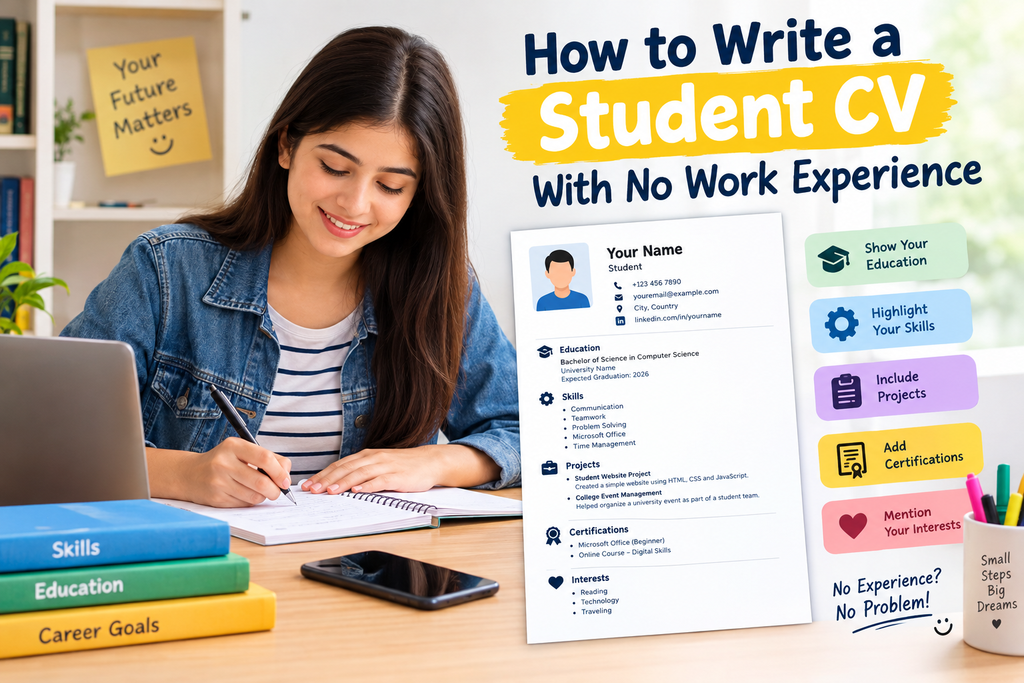
8. Keep Your Student CV Simple and Professional
A professional CV does not need expensive design software or complicated graphics. In most cases, a clean layout with clear headings is enough.
For a student with limited experience, one page is usually a good target. If you have several relevant projects or achievements, a second page may be reasonable, but avoid adding unnecessary information simply to make the document longer.
Use a readable font such as Arial, Calibri, or Aptos. Keep the font size consistent and use bold text for headings.
Organize your CV into clear sections, such as:
- Contact Information
- Personal Profile
- Education
- Skills
- Projects
- Volunteer Experience or Activities
- Certifications
Choose a simple design that makes your information easy to scan. Avoid excessive colors, decorative graphics, and complicated layouts that might make your CV difficult to read.
Unless an employer requests another format, saving your CV as a PDF is generally a good choice because it helps preserve the document’s layout.
9. Use Keywords From the Job Description
If you want your student CV to perform well when applying online, pay attention to the words used in the job advertisement.
Employers often describe the skills, qualifications, and responsibilities they expect from candidates. These details can help you decide which parts of your background to emphasize.
For example, if a job advertisement mentions communication, organization, computer literacy, and teamwork, include those terms when they accurately describe your abilities.
If the position requires basic Excel knowledge and you have learned Excel, mention it clearly in your skills section.
However, never copy every keyword into your CV without considering whether it applies to you. Your goal is to demonstrate a genuine match between your current abilities and the position.
Use standard section headings and straightforward formatting, which can also make your CV easier for applicant tracking systems to process.
10. Avoid Common Student CV Mistakes
A few simple mistakes can make a student CV look less professional than it should.
First, never invent work experience or qualifications. Employers may ask questions about anything you include, so make sure you can explain every statement honestly.
Second, avoid spelling and grammar mistakes. Read your CV carefully, use a spelling checker, and ask someone you trust to review it.
Third, do not write long paragraphs about personal circumstances. Keep your information relevant to the opportunity.
Fourth, avoid using the same CV for every application without making adjustments. A CV for a retail assistant position may need different skills and examples from a CV for a software internship.
Finally, do not underestimate your abilities just because you have never worked professionally. Your education, projects, and willingness to learn can still make you a suitable candidate for an entry level opportunity.
11. Check Your CV Before Sending It
Before submitting your application, take a few minutes to review the complete document.
Check that your contact information is correct, your education details are accurate, and your skills are relevant to the position. Make sure headings are consistent and the document looks professional on a computer screen.
Read every sentence carefully and remove repeated information. Confirm that all project descriptions explain your actual contribution.
Use a clear file name, such as “Student_CV_YourName.pdf”, so the employer can identify your document easily.
You should also follow the employer’s application instructions. If the company requests a specific file format, subject line, or supporting document, make sure you follow those requirements.
A careful final review can help you present yourself as an organized and serious applicant.
Conclusion
Learning how to write a student CV with no work experience becomes much easier when you focus on the strengths you already have. You do not need a long employment history to create a professional and convincing CV.
In my view, the best approach is to highlight your education, practical skills, academic projects, certifications, and relevant activities. These details help employers understand your potential and see how you might contribute to their organization.
Keep your CV clear, honest, relevant, and easy to read. Adjust it for each opportunity, check your grammar, and make sure every section adds value to your application.
Remember that your first CV is not expected to tell the story of an established career. It is meant to show that you are ready to begin one. With careful preparation and a willingness to learn, you can create a student CV that helps you apply confidently for your first job, internship, or part time position.


