Introduction
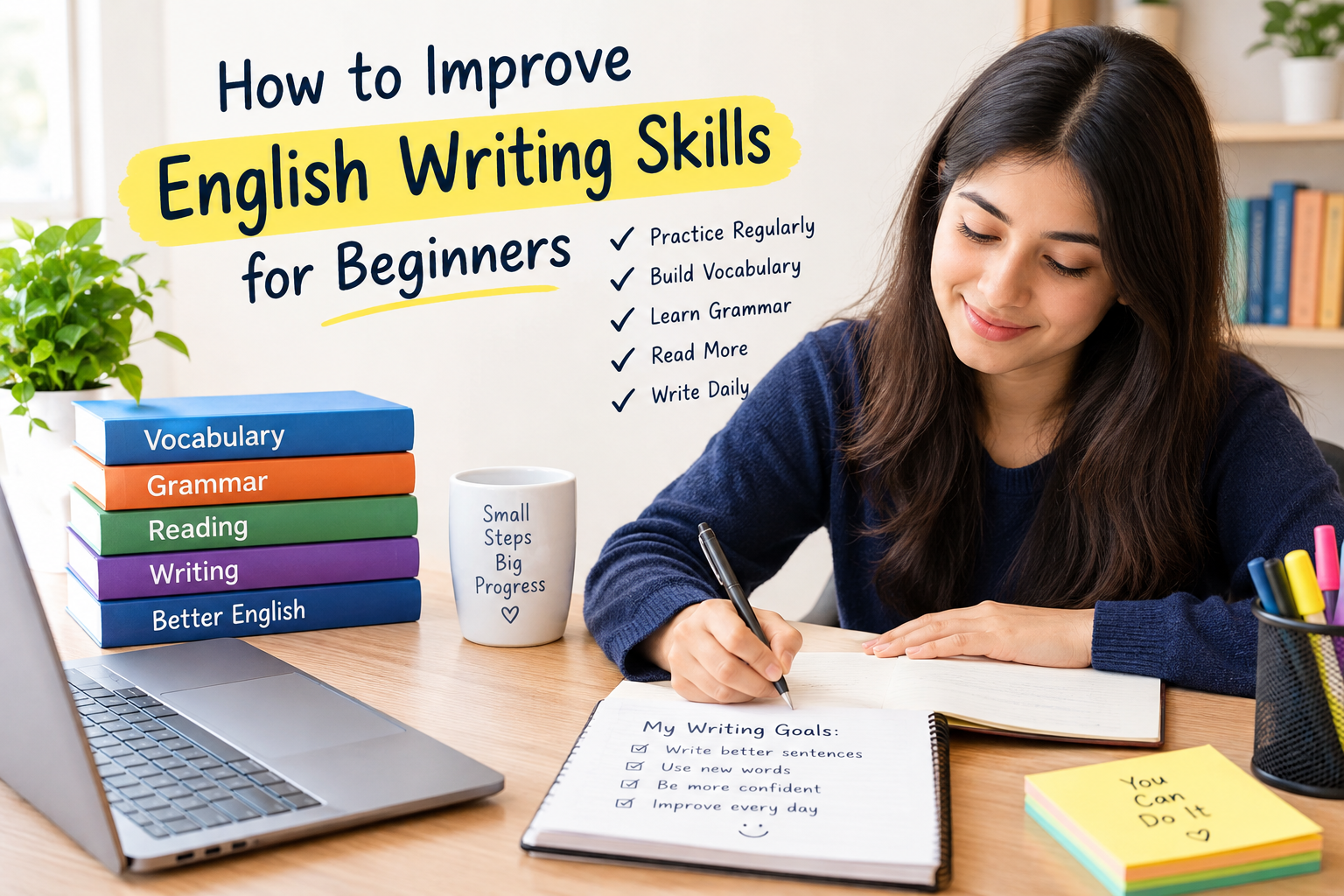
Learning how to write in English is an important skill that can help us in education, professional life, and everyday communication. Many beginners want to improve their English writing skills but do not know where to start. Some people struggle with grammar, while others find it difficult to choose the right words or organize their thoughts into meaningful sentences.
In my opinion, improving English writing skills does not require expensive courses or complicated learning methods. The most important things are regular practice, patience, reading, and a willingness to learn from mistakes. Even spending 15 to 20 minutes a day writing in English can help you make steady progress over time.
If you are a beginner, you do not need to write perfect English from the first day. Instead, focus on expressing your ideas clearly and improving a little every day. In this article, I will share practical tips to help beginners improve English writing skills naturally and confidently.
1. Start With Simple English Sentences
One of the best ways to improve English writing skills for beginners is to start with simple sentences. Many learners try to write long and complicated sentences because they believe advanced English sounds more professional. However, simple sentences are often easier to understand and help you build a strong foundation.
For example, you can begin with sentences such as:
I wake up early in the morning.
I enjoy reading books.
My favorite subject is English.
I want to improve my writing skills.
After practicing simple sentences, you can gradually combine your ideas to create longer paragraphs.
For example, instead of writing only, “I enjoy reading books,” you can write, “I enjoy reading books because they help me learn new words and improve my knowledge.”
Start with what you already know and gradually challenge yourself. This approach makes learning easier and helps you develop confidence in your writing.
2. Read English Every Day
Reading is one of the most effective ways to develop better English writing skills. When you read English regularly, you become familiar with sentence structure, grammar, vocabulary, and different writing styles.
I believe beginners should choose reading material that matches their current level. Reading difficult novels at the beginning may feel frustrating, so it is better to start with short stories, simple articles, children’s books, or beginner friendly blogs.
While reading, pay attention to how sentences are formed and how paragraphs are organized. Notice how writers introduce a topic, explain an idea, and conclude their thoughts.
You can also keep a notebook and write down useful phrases from your reading. Try using those phrases in your own sentences later.
Even reading one short English article every day can help you develop a better understanding of written English.
3. Build Your English Vocabulary
A strong vocabulary helps you express your thoughts more clearly. Beginners sometimes repeat the same words because they do not know alternative ways to explain their ideas.
To improve your vocabulary, learn a few useful English words every day. You do not need to memorize dozens of words at once. Learning three to five words and understanding how to use them correctly can be more helpful than memorizing a long list without practice.
For example, if you learn the word “improve,” create sentences such as:
I want to improve my English.
Reading helps me improve my vocabulary.
I practice daily to improve my writing.
This method helps you understand the meaning of a word and how it works in different sentences.
You can use a dictionary to check meanings, pronunciation, and example sentences. Try to learn common words before focusing on rare or complicated vocabulary.
Remember that good writing is not about using the most difficult words. It is about choosing the right words to communicate your message clearly.
4. Learn Basic English Grammar
Grammar plays an important role in English writing because it helps readers understand your message. If sentences have incorrect verb forms, confusing word order, or missing punctuation, the meaning may become difficult to understand.
As a beginner, focus on the most useful grammar rules first. These include nouns, pronouns, verbs, adjectives, articles, prepositions, and basic sentence structure.
You should also practice the present, past, and future tenses.
For example:
Present tense: I study English every day.
Past tense: I studied English yesterday.
Future tense: I will study English tomorrow.
Learning these basic patterns will help you write about daily activities, past experiences, and future plans.
Do not try to master every grammar rule in one day. Choose one topic, understand it, and practice writing sentences with it. As your knowledge improves, gradually move to more advanced grammar.
5. Make Daily Writing a Habit
Regular writing practice is essential if you want to improve English writing skills. You can understand grammar rules and memorize vocabulary, but you also need to apply what you learn.
In my view, the best approach is to make writing part of your daily routine. Set aside 15 to 20 minutes and write about something familiar.
You can write about your daily routine, favorite food, family activities, educational goals, hobbies, or personal experiences.
For example, you could write a short paragraph about what you did during the day. Do not worry if you make mistakes. The purpose is to practice expressing your thoughts in English.
Try to increase the length and complexity of your writing gradually. Start with five sentences, then move to a short paragraph, and eventually write complete articles or essays.
Consistency matters more than writing a large amount once and then stopping for several days.
6. Practice Writing Short Paragraphs
After learning simple sentences, the next step is to practice writing short paragraphs. A paragraph usually develops one main idea and supports it with relevant details.
For example, if your topic is “My Favorite Hobby,” you can explain what your hobby is, why you enjoy it, and how it benefits you.
A simple paragraph might look like this:
“My favorite hobby is reading books. I enjoy reading because it helps me learn new things and develop my imagination. I usually read in the evening when I have free time. Reading also helps me learn new English words. I believe this hobby is useful for both education and personal development.”
Notice that every sentence relates to the same topic.
When writing a paragraph, begin with a clear main idea. Add two or three supporting details and finish with a sentence that completes your thought.
This technique is useful for school assignments, blog posts, emails, and everyday written communication.
7. Improve Your Sentence Structure
Sentence structure determines how words and ideas are arranged. Good sentence structure makes writing easier to read and understand.
Beginners often write sentences that are too short and repetitive. Others create very long sentences that contain too many ideas.
To improve, practice combining related sentences and using simple connecting words.
Useful connecting words include “and,” “but,” “because,” “so,” “although,” and “however.”
For example:
“I was tired. I completed my homework.”
You can write, “Although I was tired, I completed my homework.”
Another example is, “I practice English. I want to improve my writing.”
You can combine these ideas as, “I practice English because I want to improve my writing.”
Use connecting words naturally and avoid putting too many ideas into one sentence. Clear writing is usually more effective than unnecessarily complicated writing.
8. Write About Topics You Already Know
Writing becomes easier when you choose familiar topics. Beginners may struggle when they attempt to explain complicated subjects before developing basic writing skills.
Start with topics from everyday life, such as your morning routine, favorite meal, hometown, educational experience, or future goals.
When you write about something you know, you can focus on sentence formation instead of spending too much time searching for information.
As your confidence grows, explore more challenging topics such as education, technology, healthy habits, travel, and personal development.
You can also practice writing your opinions about simple everyday issues. Explain what you think, why you think it, and provide an example.
This practice helps you develop the ability to organize your thoughts and communicate your ideas clearly.
9. Review and Correct Your Mistakes
One important step in learning how to improve English writing skills for beginners is reviewing your work. Writing something once is useful, but checking it afterward helps you identify areas that need improvement.
After completing a paragraph, read it slowly. Check whether each sentence makes sense and whether the words are spelled correctly.
Pay attention to capital letters, punctuation, verb forms, and repeated words.
You can also read your writing aloud. Sometimes, a sentence that looks correct on the screen sounds confusing when spoken.
Grammar checking tools can help identify common mistakes, but you should try to understand the corrections rather than accepting every suggestion automatically.
Keep a record of the mistakes you frequently make. If you often confuse past and present tense, spend extra time practicing that topic.
Learning from repeated mistakes is an important part of becoming a better writer.
10. Use Online Resources to Learn English
Many free resources are available to help beginners improve English writing skills. You can use online dictionaries, grammar lessons, writing exercises, and educational videos.
Choose resources that explain concepts clearly and provide practical examples. You do not need to use every available learning website. Selecting a few reliable resources and using them regularly is often more effective.
You can also use AI learning tools to generate writing prompts, explain grammar rules, or provide feedback on a paragraph.
For example, write a short paragraph and ask for help identifying grammar mistakes and unclear sentences. Review the feedback and rewrite the paragraph yourself.
The goal should be to develop your own writing ability, not simply copy corrected sentences. Active practice helps you understand why a particular sentence works better than another.
11. Learn to Organize Your Ideas
Good English writing requires more than correct grammar. Your ideas should follow a logical order so readers can understand your message without confusion.
Before writing a paragraph or article, take a few minutes to plan what you want to say.
For a longer article, you can divide your content into an introduction, main sections, and a conclusion. For a short paragraph, write down the main point and two or three supporting details.
For example, if you are writing about the benefits of exercise, you might discuss physical fitness, mental well being, and the importance of consistency.
Use headings when appropriate and keep each paragraph focused on one main idea.
Planning does not need to be complicated. Even a short list of ideas can make writing easier and prevent you from repeating the same information.
12. Follow a Simple Daily Writing Routine
A daily routine can help you practice consistently without feeling overwhelmed.
Here is a simple 20 minute writing routine for beginners:
First 5 minutes: Read a short English passage and notice useful words or sentence patterns.
Next 5 minutes: Learn three new words and write one sentence using each word.
Next 7 minutes: Write a short paragraph about a familiar topic.
Final 3 minutes: Review your paragraph and correct any mistakes you can identify.
You can follow this routine at home, during a study break, or whenever you have free time.
At the end of each week, compare your recent writing with your earlier work. Look for improvements in sentence structure, vocabulary, spelling, and clarity.
Small improvements may seem unimportant at first, but regular practice can help you become a more confident writer.
Common Mistakes Beginners Should Avoid
When learning English writing, it is important to avoid habits that slow your progress.
First, do not focus only on memorizing vocabulary. Practice using new words in meaningful sentences.
Second, do not worry too much about making mistakes. Mistakes are a normal part of learning, and reviewing them helps you improve.
Third, avoid translating every sentence word for word from your native language. English sentence structure may be different, so learn common English patterns through reading and practice.
Fourth, do not copy entire paragraphs from other writers and treat them as your own work. Read examples to understand the writing style, then express the ideas in your own words.
Finally, do not expect instant results. Writing is a skill that develops gradually through consistent effort.
Conclusion
Learning how to improve English writing skills for beginners becomes easier when you follow simple methods and practice regularly. Start with basic sentences, read English every day, build your vocabulary, learn essential grammar, and write short paragraphs about familiar topics.
In my opinion, the most important factor is consistency. You do not need to spend hours studying English every day. Even a small amount of focused practice can help you develop better writing habits over time.
Remember to review your work, learn from your mistakes, and organize your ideas before writing. As your confidence grows, challenge yourself with longer paragraphs, essays, and articles.
The journey to better English writing starts with one sentence. Keep practicing, stay patient, and focus on progress rather than perfection. With time and effort, you can improve your English writing skills and express your ideas more clearly in everyday life.