Introduction
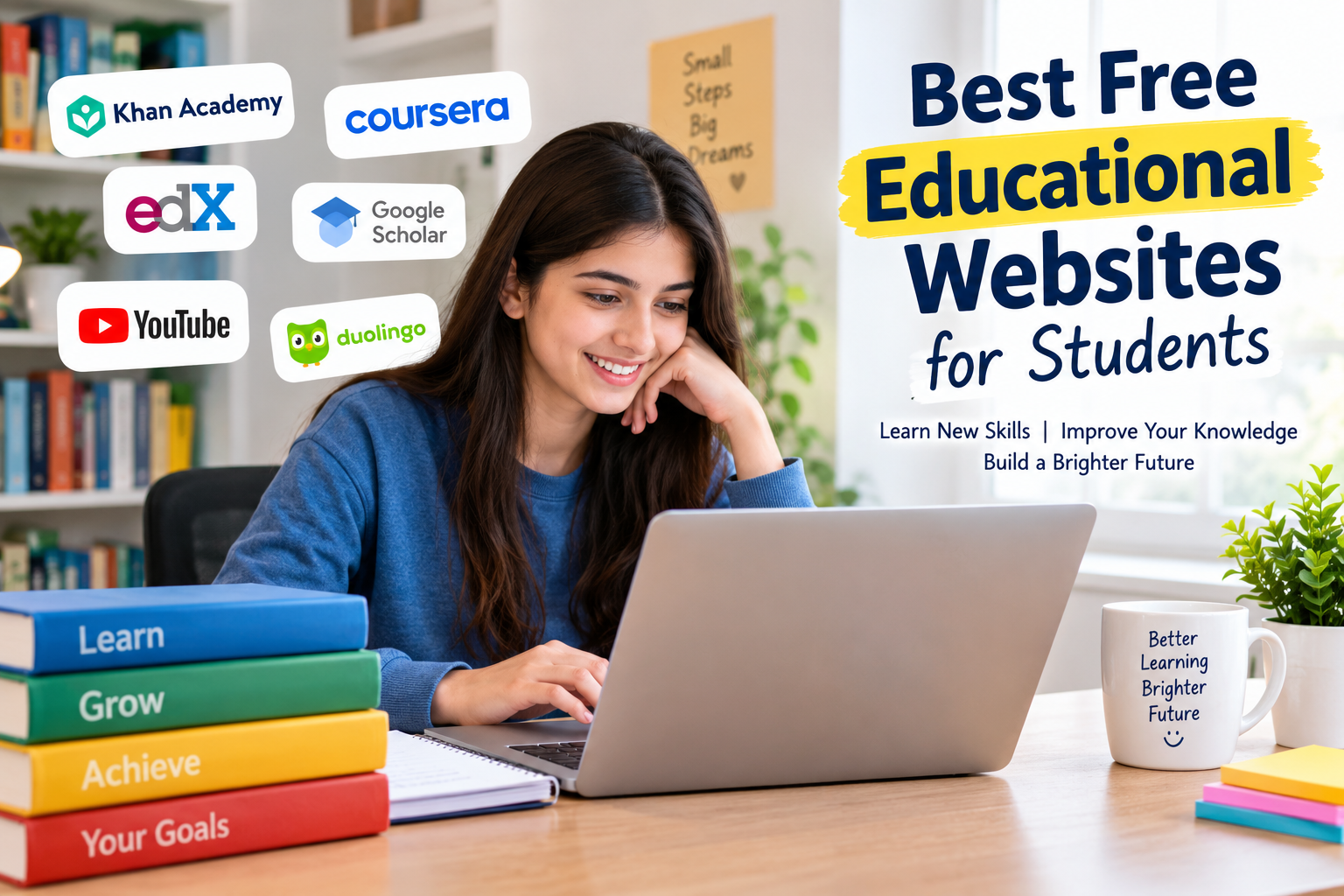
Education has become easier to access because students can now learn almost anything through the internet. In the past, students often depended on textbooks, school libraries, and classroom lessons to gain knowledge. Today, many free educational websites provide lessons, practice exercises, video tutorials, and learning resources that can help students improve their skills from home.
In my opinion, using the best free educational websites for students is one of the simplest ways to make learning more flexible and affordable. Students can study difficult subjects at their own pace, explore new interests, and prepare for examinations without spending a lot of money. These websites are also useful for students who want to learn computer skills, improve their English, or develop knowledge beyond their regular school curriculum.
However, choosing the right learning platform is important. Some websites are better for mathematics, while others focus on science, languages, technology, or academic research. In this article, I will explain some of the best free educational websites for students and how they can be used to make learning more productive.
1. Khan Academy
Khan Academy is one of the best free educational websites for students who want to understand academic subjects more clearly. It offers educational videos, practice questions, and learning exercises covering subjects such as mathematics, science, economics, and computing.
One of the main advantages of Khan Academy is its beginner friendly approach. Students can study a topic step by step instead of trying to understand everything at once. If a student struggles with algebra, for example, they can review basic mathematical concepts before moving to more advanced lessons.
I believe this website is especially helpful for students who need extra practice outside the classroom. They can repeat lessons whenever necessary and use exercises to check their understanding.
Website: https://www.khanacademy.org
2. Coursera
Coursera is a popular online learning platform that provides courses from universities, educational institutions, and professional organizations. Students can explore subjects such as business, computer science, communication, data analysis, and personal development.
Although many Coursera courses require payment for certificates or certain features, some courses offer free access to learning materials or an audit option. Availability depends on the individual course, so students should check the current enrollment details before joining.
Coursera can be useful for students who want to learn skills beyond their school or college subjects. For example, a student interested in technology can explore introductory programming courses, while someone interested in business can study basic marketing concepts.
My recommendation is to begin with a course that matches a specific learning goal. Completing one suitable course is often more valuable than enrolling in several courses without finishing them.
Website: https://www.coursera.org
3. edX
edX is another valuable educational platform that offers online courses from universities and other learning institutions. Its subjects include computer science, engineering, mathematics, business, and humanities.
Students can use edX to explore topics that may not be covered in detail in their regular classes. It is particularly useful for learners who want to understand university level subjects or prepare for future academic studies.
Some courses provide free access to learning materials, while certificates and other options may require payment. Students should review the course information carefully to understand what is included at no cost.
I consider edX a good choice for motivated students who enjoy structured learning. Following a course schedule, watching lectures, and completing available exercises can help students develop discipline and a deeper understanding of their chosen subjects.
Website: https://www.edx.org
4. YouTube
YouTube is one of the most accessible free learning resources available online. Although it is mainly known as a video sharing platform, it contains thousands of educational channels covering almost every academic subject.
Students can find tutorials about mathematics, physics, chemistry, English grammar, computer programming, history, and many other topics. Visual explanations can make difficult concepts easier to understand, especially when a teacher demonstrates a process or solves a problem step by step.
For example, if I wanted to understand a difficult science concept, I could search for a beginner friendly explanation and compare different teaching styles until the topic became clearer.
However, students should choose reliable educational channels and verify important information when necessary. Not every video contains accurate or complete information.
It is also important to avoid spending too much time watching unrelated videos. Searching for a specific topic and taking notes during the lesson can make YouTube a more effective educational tool.
Website: https://www.youtube.com
5. BBC Learning English
BBC Learning English is an excellent resource for students who want to improve their English language skills. It offers lessons covering grammar, vocabulary, pronunciation, listening, and everyday communication.
Students can use its learning materials to understand common English expressions and improve their ability to follow spoken English. Regular practice can also help learners become more comfortable with reading and writing.
In my view, this website is particularly useful for students who want to improve their English without paying for private lessons. Listening to short lessons and writing down unfamiliar words can gradually improve vocabulary.
Students should also practise using new words in their own sentences. Learning a word is only the first step. Using it in writing and conversation helps make the knowledge more useful.
Website: https://www.bbc.co.uk/learningenglish
6. Duolingo
Duolingo is a language learning platform designed to make practice accessible through short, interactive lessons. Students can use it to study languages such as Spanish, French, German, and other languages available on the platform.
Its activities focus on vocabulary, sentence structure, translation, and other language skills. Short lessons can make it easier to develop a regular study habit, particularly for beginners.
The platform offers a free learning experience, although certain features may require a paid subscription.
I think Duolingo works best when students use it consistently rather than completing many lessons in a single day and then stopping for a week. Even a short daily practice session can help learners maintain their progress.
However, students who want to become fluent should combine app based lessons with reading, listening, writing, and real conversations whenever possible.
Website: https://www.duolingo.com
7. Google Scholar
Google Scholar is a useful search tool for students who need academic information for assignments, research projects, and presentations. It helps users find scholarly articles, research papers, theses, books, and other academic materials.
Instead of relying entirely on ordinary search results, students can use Google Scholar to discover research related to a specific subject. For example, someone preparing a project about environmental pollution can search for academic studies discussing its causes and effects.
Not every result provides free full text access. Some publications require payment or access through an educational institution. Nevertheless, many researchers make free versions of their work available.
Students should learn to evaluate the sources they find, check publication details, and avoid copying text directly into assignments without proper attribution.
I recommend using Google Scholar when a school or college project requires evidence from credible academic sources.
Website: https://scholar.google.com
8. MIT OpenCourseWare
MIT OpenCourseWare provides free educational materials from many courses taught at the Massachusetts Institute of Technology. Its resources include lecture notes, assignments, reading materials, and other course content.
Students interested in engineering, mathematics, computer science, physics, and related subjects can use these materials to explore advanced topics.
One of the most useful features is that learners can study many resources independently without following a traditional classroom schedule. This makes the platform suitable for students who want to challenge themselves beyond their current syllabus.
However, some materials may be difficult for complete beginners because they are designed for university level study. I suggest reviewing the course description and starting with introductory material before attempting advanced lessons.
Students should also understand that accessing course materials does not automatically provide an official qualification or certificate.
Website: https://ocw.mit.edu
9. OpenLearn
OpenLearn is a free learning platform provided by The Open University. It offers courses and educational resources covering subjects such as psychology, history, business, science, health, and personal development.
The platform is useful for students who want to explore new interests or improve their understanding of a subject outside their regular studies. Many learning materials are organized into manageable sections, making them easier to follow.
Some courses also provide statements of participation or digital badges when learners complete the relevant requirements. Students should check the details of each course to understand what recognition is available.
I believe OpenLearn is a good option for independent learners who enjoy reading educational material and following structured lessons.
Website: https://www.open.edu/openlearn
10. GCFGlobal
GCFGlobal is a helpful educational website for students who want to develop practical computer and digital skills. Its learning resources cover topics such as computer basics, internet use, email, office software, reading, mathematics, and workplace skills.
Students who are new to computers can benefit from its straightforward explanations and tutorials. Learning how to manage files, use spreadsheets, create documents, and navigate online tools can make schoolwork easier.
These skills are useful for assignments, presentations, research projects, and future employment.
In my opinion, GCFGlobal is especially valuable for beginners because it breaks practical topics into understandable lessons. Students can choose a skill they need and practise it without having to complete an entire academic course.
Website: https://edu.gcfglobal.org
11. National Geographic Education
National Geographic provides educational content that can help students explore geography, wildlife, environmental science, cultures, and the natural world.
Its articles, photographs, videos, and educational resources can make learning more engaging by connecting classroom subjects with real world examples.
For example, students studying ecosystems can explore information about habitats and wildlife. Those learning geography can discover different environments, communities, and geographical features.
I find this type of resource helpful because learning becomes more interesting when students can connect facts with real examples. It can also encourage curiosity and independent research.
Students should check the availability and intended audience of individual resources, as some materials are designed specifically for educators or particular age groups.
Website: https://education.nationalgeographic.org

Benefits of Using Free Educational Websites
Free educational websites offer several advantages for students who want to improve their academic performance and develop new skills.
Affordable Learning Opportunities
One of the biggest advantages is the ability to access many educational resources without paying tuition or purchasing additional textbooks. Students can explore different subjects before deciding whether they want to invest in a paid course.
However, some websites offer paid certificates, subscriptions, or advanced features, so it is important to understand which resources are genuinely free.
Flexible Study Schedules
Online learning allows students to study at convenient times. They can review lessons after school, practise on weekends, or use short periods throughout the day.
This flexibility is especially useful for students who have family responsibilities or limited access to additional classroom instruction.
Improved Academic Performance
Students can use online tutorials and exercises to revisit difficult subjects. Practising mathematics, reviewing science concepts, or improving grammar can strengthen their understanding over time.
The key is to use these resources alongside schoolwork rather than treating them as a complete replacement for teachers, textbooks, and classroom activities.
Development of Practical Skills
Educational websites also help students develop computer skills, communication abilities, research techniques, and language knowledge.
These skills can support academic progress and prepare students for future studies and employment.
How to Choose the Best Educational Website
Choosing the right website depends on your learning needs. Before starting, identify the subject you want to improve and the specific result you hope to achieve.
If you need help with school subjects, Khan Academy may be a suitable starting point. For language practice, consider BBC Learning English or Duolingo. If you want to explore university level courses, review Coursera, edX, or MIT OpenCourseWare. For academic research, Google Scholar can help you discover relevant studies.
You should also consider your current skill level. Beginners often benefit from simple explanations and guided exercises, while advanced learners may prefer detailed lectures and challenging assignments.
Check whether the website offers free access to the materials you need. If you want a certificate, confirm whether it is included or requires payment.
Finally, choose resources that are easy to use on your available device and internet connection. A website that fits your circumstances is more likely to become part of your regular learning routine.
Tips for Getting Better Results From Online Learning
Finding a good website is only the beginning. Students also need a practical learning routine.
First, set a clear goal for each study session. Instead of deciding to study science generally, choose one chapter or concept to understand.
Second, take notes while watching lessons or reading educational material. Writing down important ideas helps you review the information later.
Third, practise what you learn. Complete exercises, answer questions, solve problems, or create a small project related to the topic.
Fourth, review previous lessons regularly. Returning to information after some time can help strengthen your understanding.
Finally, reduce distractions while studying. Keep unnecessary browser tabs closed, silence nonessential notifications, and take short breaks when needed.
A consistent routine of 20 to 30 minutes a day can be a practical starting point. The ideal study time depends on your schedule, goals, and the difficulty of the subject.
Conclusion
The best free educational websites for students make learning more flexible, affordable, and accessible. Platforms such as Khan Academy, Coursera, edX, YouTube, BBC Learning English, Duolingo, Google Scholar, MIT OpenCourseWare, OpenLearn, GCFGlobal, and National Geographic Education offer different ways to develop knowledge and skills.
In my opinion, the most effective approach is to choose a website that matches your current needs and use it consistently. You do not need to join every platform or study several subjects at once. Start with one useful resource, set a realistic goal, practise regularly, and measure your progress.
Remember that online learning works best when combined with active practice, careful research, and a willingness to ask questions. By making good use of free educational websites, students can improve their academic knowledge, develop valuable skills, and prepare themselves for future opportunities without putting unnecessary pressure on their budget.