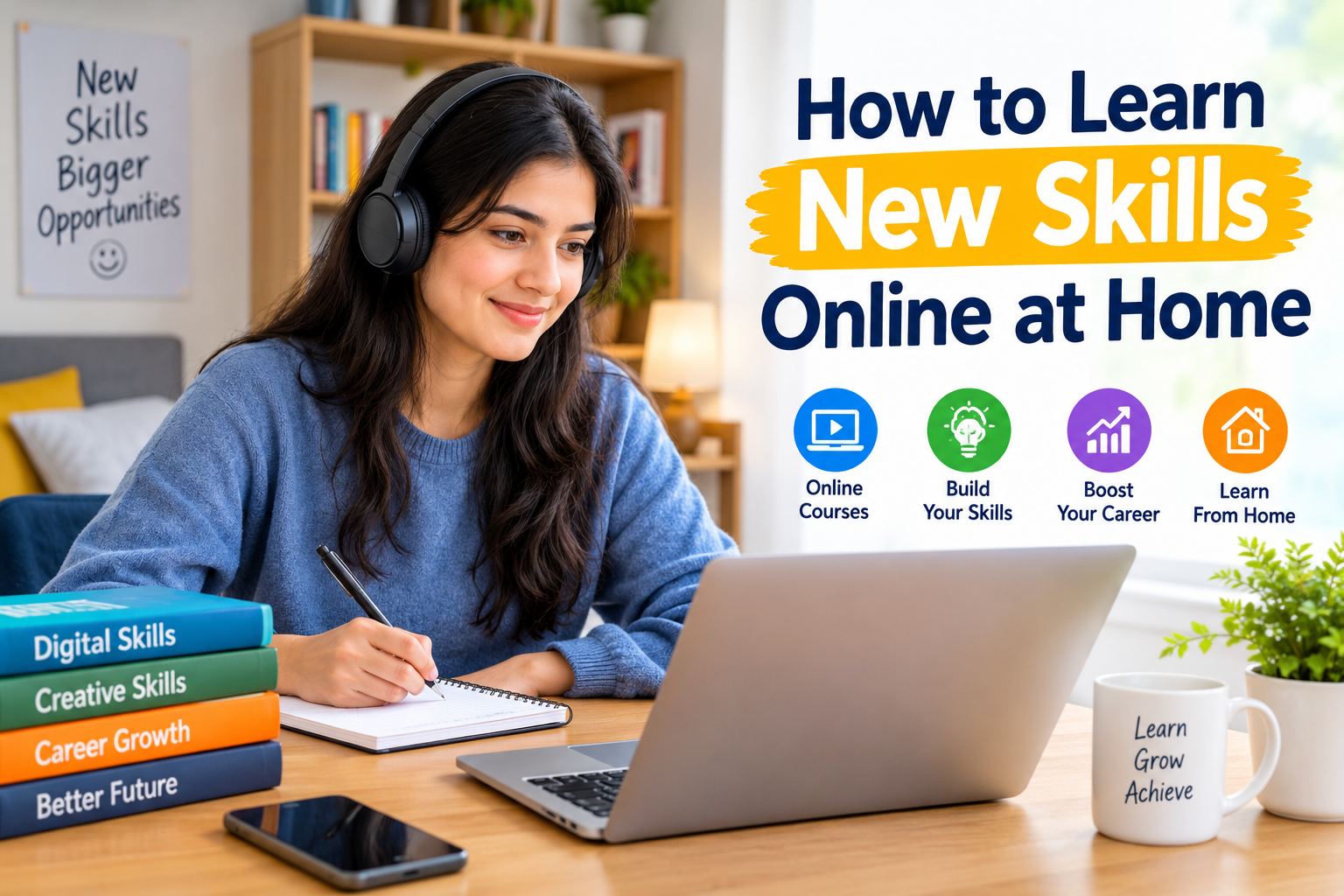
Learning new skills online at home has become one of the most convenient ways to improve personal knowledge, develop professional abilities, and explore new interests. With an internet connection, a computer or smartphone, and a little dedication, almost anyone can begin learning something useful without leaving home. Whether you want to improve your communication, learn graphic design, understand digital marketing, develop computer skills, or explore a new hobby, online learning gives you the flexibility to study at your own pace.
In my opinion, the best way to learn new skills online is to start with a clear goal and follow a simple routine. Many people spend hours watching tutorials but struggle to apply what they learn. The real benefit comes when you combine quality learning resources with regular practice and patience.
You do not need expensive equipment or a perfect study environment to get started. What matters most is choosing the right skill, finding reliable resources, and consistently putting your knowledge into practice. In this guide, I will explain practical ways to learn new skills online at home and make your learning journey more productive.
1. Choose a Skill That Matches Your Goals
The first step in learning new skills online is deciding what you actually want to learn. There are thousands of online courses, tutorials, and educational websites available, so choosing a direction can feel overwhelming. Instead of trying to learn everything at once, focus on one skill that matches your interests or future plans.
For example, if you enjoy creative work, you might learn graphic design, photography, video editing, or content writing. If you want to improve your professional opportunities, consider learning spreadsheet software, communication, coding, or digital marketing.
Think about why you want to develop a particular skill. Do you want to improve your current job performance, prepare for a new career, start a small business, or enjoy a productive hobby? Having a clear reason makes it easier to remain motivated.
Write down one specific goal before you begin. Instead of saying, “I want to learn computers,” you could say, “I want to learn basic spreadsheet skills and create a monthly budget.” A specific goal helps you understand what to study and how to measure your progress.
2. Find Reliable Online Learning Resources
Once you have selected a skill, the next step is finding useful learning materials. You can learn through online courses, educational videos, digital books, practice websites, and tutorials created by experienced instructors.
Some popular resources include YouTube for free video tutorials, Coursera for structured courses, Khan Academy for academic subjects, and freeCodeCamp for programming lessons. Availability, course access, and certificates can vary, so check the details before enrolling.
Do not choose a course simply because it has an attractive title. Look at the syllabus, instructor experience, learner feedback, and practical exercises. A good beginner course should explain concepts clearly and gradually introduce more challenging material.
It is also helpful to select one main learning resource instead of switching between many different websites. Constantly changing courses can create confusion and prevent you from completing anything.
Choose a resource that suits your current level, then follow it consistently until you understand the fundamentals.
3. Create a Simple Learning Schedule
One of the biggest advantages of online learning is flexibility. You can study in the morning, during a lunch break, or in the evening. However, having complete flexibility can sometimes make it difficult to remain consistent.
That is why creating a simple study schedule is important.
Start with 20 to 30 minutes of focused learning each day. If you have more free time, you can gradually increase your sessions. The important thing is to choose a routine that fits your normal responsibilities.
For example, you might watch a lesson for 15 minutes, spend another 15 minutes taking notes, and use the remaining time to complete a small exercise.
Try to study at approximately the same time each day. This makes learning easier to fit into your routine and reduces the temptation to postpone it.
You do not have to study for several hours every day to make progress. A short, focused session can be more useful than a long session filled with distractions.
Consistency helps you build familiarity with new concepts and gives you regular opportunities to practice what you have learned.
4. Set Up a Comfortable Study Space at Home
Your learning environment can affect how well you concentrate. You do not need a separate office or an expensive desk to learn new skills online. A quiet corner of your room can be enough if it helps you focus.
Choose a place where you can comfortably use your laptop, read course materials, and write notes. Keep the items you need nearby, such as a notebook, pen, headphones, and charger.
Try to keep your study area organized. A cluttered desk can make it harder to find things and may distract you from your lesson.
Lighting and comfort also matter. Sit in a comfortable position, keep your screen at a suitable height, and take short breaks when necessary.
If your home is noisy, consider studying when other people are less active or using headphones to reduce distractions.
The purpose of creating a study space is to make learning easier and more enjoyable. Even a small improvement in your environment can help you develop a more consistent learning habit.
5. Practice What You Learn Every Day
One of the most effective ways to learn new skills online at home is to practice regularly. Watching videos and reading explanations can help you understand information, but practical experience helps you use that knowledge.
For example, if you are learning graphic design, create a simple poster after watching a tutorial. If you are studying content writing, write a short article using the techniques you have learned. If you are learning coding, write small programs instead of only watching someone else write code.
Practice does not have to involve complicated projects. Start with simple exercises that match your current ability.
When you make mistakes, try to understand what went wrong. Mistakes are a normal part of the learning process and can show you which areas need more attention.
I believe learners make better progress when they spend less time passively consuming information and more time applying it.
A useful approach is to divide your learning session into three parts: understanding a concept, practicing it, and reviewing the result. This helps turn new information into a skill you can use independently.

6. Break Large Goals Into Smaller Tasks
Learning a complicated skill can feel difficult when you try to understand everything at once. Breaking your goal into smaller tasks makes the process easier to manage.
Suppose you want to learn video editing. Instead of trying to master an entire editing program immediately, divide the process into simple stages.
First, learn how to import video files. Next, practice cutting clips, adding transitions, adjusting audio, and inserting text. Once you understand these basics, move on to color correction and more advanced editing techniques.
The same approach works for learning a language, improving writing, studying mathematics, or developing computer skills.
Create a checklist of the topics you want to understand. Mark each task as completed when you can perform it confidently without following every instruction.
Small achievements can help you stay motivated because you can see your progress clearly.
Remember that learning a new skill is a gradual process. You do not need to become an expert in a week. Focus on completing one manageable task at a time.
7. Take Notes and Review Important Information
Taking notes is another useful way to improve online learning. When you write down important ideas in your own words, you have an opportunity to process the information rather than simply hearing or reading it.
Your notes do not need to be lengthy. Write down key concepts, important steps, examples, and questions you want to investigate later.
For instance, if you are learning spreadsheet formulas, record the formula, explain what it does, and include a simple example. If you are learning a language, write down new words and create sentences using them.
Review your notes regularly instead of waiting until you have forgotten the material.
You can review the previous lesson before starting a new one or spend a few minutes at the end of each week revisiting important concepts.
Testing yourself is particularly useful. Close your notes and try to explain what you learned without looking at the original material. If you cannot explain something clearly, return to that topic and practice again.
This method helps you identify knowledge gaps and decide what to study next.
8. Avoid Distractions During Online Learning
Distractions are among the most common challenges when learning new skills at home. Social media, messages, entertainment videos, and unnecessary browsing can interrupt your concentration.
Before starting a lesson, silence nonessential notifications and close unrelated browser tabs. If you use your phone for learning, consider temporarily blocking distracting applications.
You can also use a timer to organize your study sessions. For example, focus on one lesson for 25 minutes and then take a five minute break. Adjust the session length according to your attention span and the difficulty of the topic.
Avoid trying to study several unrelated skills at the same time. Learning graphic design, coding, marketing, and a new language simultaneously may leave you feeling busy without making meaningful progress in any one area.
Choose one primary skill and give it most of your attention until you have developed a solid foundation.
You can explore other interests later. Focused learning often makes it easier to understand complicated subjects and complete practical projects.
9. Use Free Learning Resources Before Spending Money
You do not always need to purchase an expensive course to learn a valuable skill. Many websites offer free lessons, tutorials, practice exercises, and educational materials.
Before paying for a course, explore free resources to understand whether the subject interests you. This is especially useful if you are a beginner and are not yet certain which direction you want to follow.
However, free resources should still be evaluated carefully. Check whether the information is accurate, current, and appropriate for your learning level.
Paid courses can be useful when they offer structured lessons, personal feedback, recognized assessments, or other features that genuinely meet your needs. Compare the course content and total cost before making a decision.
Avoid purchasing several courses at once simply because they are discounted. It is usually better to complete one suitable course than to collect multiple courses without finishing them.
If your goal is to develop practical abilities, prioritize resources that include exercises, assignments, and opportunities to create something yourself.
10. Build a Portfolio to Show Your Progress
If you are learning a skill for professional development, creating a portfolio can be extremely helpful. A portfolio is a collection of examples that demonstrates what you can do.
For example, a beginner graphic designer can save sample posters, logos, and social media designs. A content writer can collect blog posts and product descriptions. Someone learning web development can build small websites or simple applications.
Your first projects do not need to be perfect. Their purpose is to help you practice, identify weaknesses, and demonstrate gradual improvement.
Keep your work organized in folders or on a suitable online platform. As your skills improve, update your portfolio with stronger examples.
A portfolio can help you communicate your abilities when applying for opportunities or approaching potential clients. However, it does not guarantee employment or income. Your results will also depend on your skill level, experience, communication, and the opportunities available.
Even if you are learning purely for personal interest, saving your projects gives you a useful record of your progress.
11. Measure Your Progress and Stay Motivated
Learning a new skill takes time, and progress is not always obvious from one day to the next. Setting milestones helps you recognize improvement and maintain motivation.
At the beginning of your learning journey, identify what you want to accomplish within a week or a month.
For example, your first week might involve understanding the basics of a design program. Your second week might focus on creating simple designs. By the end of the month, you could aim to complete three small projects.
Keep a record of what you have learned and which tasks you can now perform independently.
Do not compare your early results with the work of experienced professionals. People who appear naturally talented have often spent many hours practicing and improving.
If you miss a study session, return to your routine as soon as possible instead of abandoning your goal.
Motivation can change from day to day, so build habits that help you continue even when you do not feel particularly enthusiastic.
Common Mistakes to Avoid When Learning Online
Several mistakes can slow down your progress when learning new skills online at home.
First, avoid switching between courses too frequently. Give one suitable learning resource enough time to teach you the fundamentals.
Second, do not rely entirely on watching tutorials. Practice is essential if you want to develop skills you can use independently.
Third, avoid setting unrealistic expectations. Learning a useful skill may take weeks or months, depending on its complexity and the time you can dedicate to it.
Finally, do not ignore feedback. Ask knowledgeable people to review your work when possible, compare your results with clear examples, and identify areas for improvement.
Understanding these mistakes can help you use your time more effectively and build a more sustainable learning routine.
Conclusion
Learning new skills online at home is a practical way to improve your knowledge, explore personal interests, and prepare for future opportunities. With the right learning resources, a clear goal, and regular practice, you can develop useful abilities without needing to attend a traditional classroom.
Start by choosing one skill that matches your interests. Create a realistic study schedule, organize a comfortable learning space, and practice what you learn through small projects. Review your progress regularly and adjust your approach whenever necessary.
In my view, the most important part of learning online is consistency. You do not need to know everything at the beginning, and you do not need to make rapid progress every day. What matters is continuing to learn, applying your knowledge, and improving gradually.
Choose one skill today, find a reliable learning resource, and complete your first lesson. Small steps can eventually lead to meaningful personal and professional growth.
Frequently Asked Questions
1. What are the best skills to learn online at home?
Some useful options include content writing, graphic design, coding, digital marketing, video editing, communication, spreadsheet skills, and foreign languages. The best choice depends on your interests, goals, and available time.
2. Can I learn new skills online for free?
Yes. Many educational websites and video platforms offer free lessons and practice materials. You can begin learning without purchasing a course, although some advanced resources and certificates may require payment.
3. How much time should I spend learning a new skill each day?
Beginners can start with 20 to 30 minutes daily and increase their study time as needed. Consistent practice is generally more manageable than occasional, lengthy sessions.
4. How can I stay motivated while learning at home?
Set small goals, follow a realistic schedule, track your progress, and practice through projects that interest you. Celebrate completed milestones and remember that improvement takes time.
5. Can online learning help me develop career skills?
Yes. Online learning can help you develop practical abilities relevant to different careers. Building a portfolio, completing realistic projects, and seeking constructive feedback can help you demonstrate your progress to potential employers or clients.